
Why strategy and context matter more than ever in the AI era

According to Boston Consulting Group, 74% of companies struggle to extract real value from AI. Seventy percent of those failures trace back to people and process problems. Most of the time, the tooling works. But it’s harder to get the strategy right—and to get your people and processes aligned around that strategy.
AI copilots can surface patterns, summarize data, and explore correlations faster than any analyst. But they can only work with what you give them. Feed AI fragmented metrics, conflicting definitions, and no clear picture of how your business actually grows, and you'll get fast answers that lead nowhere useful.
Why AI breaks down without context
When AI lacks business context, it can’t give you insights tailored to your unique business. This is more than a missed opportunity, it’s also a risk: If AI is pointed at a problem and comes up with a solution that misses critical context, it might suggest optimizations that end up doing more harm than good.
AI doesn’t inherently know your business model. It doesn’t know that “active user” means something different to product teams than it does to marketing, for example. It treats whatever data you give it as the complete picture. AI can’t know which metrics matter most unless you tell it. It won’t even know how your company defines metrics unless you spell that out.
If you prompt it with an incomplete picture, you’re going to get an incomplete picture in return. This can send you moving fast in the wrong direction, while believing your decisions are data-driven.
Consider this scenario for short-term rental sites
Imagine a scenario for a company like Airbnb or VRBO: AI analyzes the data and sees that listings with instant booking enabled get more bookings and higher short-term conversion. It recommends automatically turning on Instant Book for more hosts by default.
A PM rolls it out.
Bookings initially rise, but cancellations and customer support issues increase, and host churn ticks up. Why? Because some hosts relied on manual approval to screen guests and feel safe. The AI optimized for booking conversion. It didn’t understand that host retention was just as important in its strategy as bookings; for brands like these, the real moat is trust on both sides of the marketplace.
Ensuring that AI has the context it needs is the first step. Skipping that step might be faster, but speed doesn’t win if it’s wrong. A weak strategy that doesn’t include the right context provides fast but misaligned answers.
Developing a strategic direction requires human judgment and cross-team alignment
To make AI work best for you, you need a shared model of how your business works that is structured and digestible for your teams and AI copilots.
AI may be pointing a spotlight at this problem, but it’s the same problem we’ve been facing for decades: Product, growth, data, and marketing teams often operate with different metric definitions, conflicting success criteria, and fragmented mental models of how the product grows. These siloed operations have long caused issues for companies of all sizes (and especially enterprises). AI just amplifies that existing misalignment.
Aligned AI-assisted teams move faster in a shared direction. Alignment turns speed into advantage. Without it, you risk turning speed into chaos.
That’s leadership’s most important role in the AI era: establishing purpose and priorities, defining what “success” looks like, and making sure that different teams work in alignment towards shared company goals.
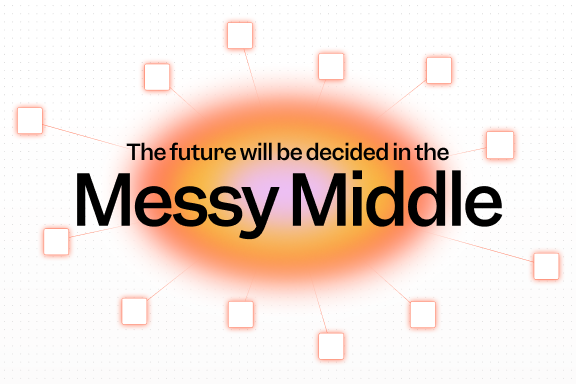
➡️ Learn more: The “messy middle” discusses the gap between the short-term behavioral metrics and long-term lagging outcomes (and how to solve it).
What’s a metric tree, and why does it matter in the AI era?
The good news is that if AI exposes the cracks in alignment, it also forces us to fix them. So how do we close the gap between high-level strategy and day-to-day metrics? One answer is the metric tree.
Metric trees translate strategy into an operational analytics framework, giving AI systems the context they need to understand your business, your goals, and how inputs connect to outcomes.
A metric tree is a structured model that maps top-level business outcomes to the input metrics and levers that drive them. It shows how lower-level metrics impact higher-level metrics and performance, all the way up to the main focus metric at the top of the tree. With metric trees, every team can see how their actions and goals impact the bigger picture. Instead of working in silos, everyone is working towards the same goals, with the same data.
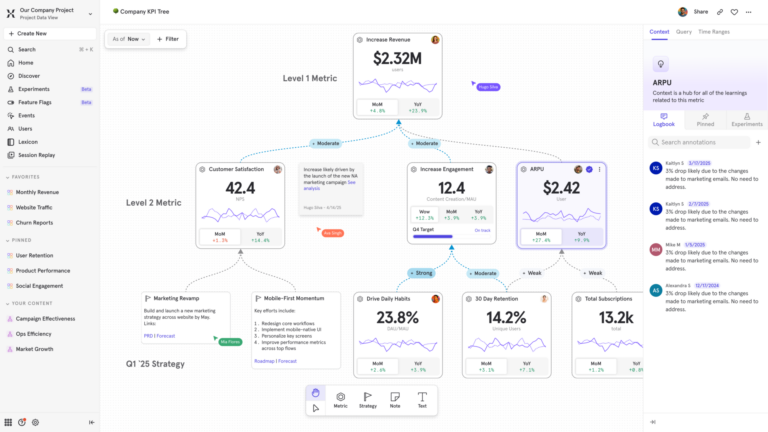
Metric trees were valuable assets even before the rise of AI, but more so during the AI era. They provide a shared, explicit model of your business strategy that all teams (and their AI copilots) can understand, which drives alignment and reduces the risk of a siloed workforce.
What becomes possible when AI understands your metric framework
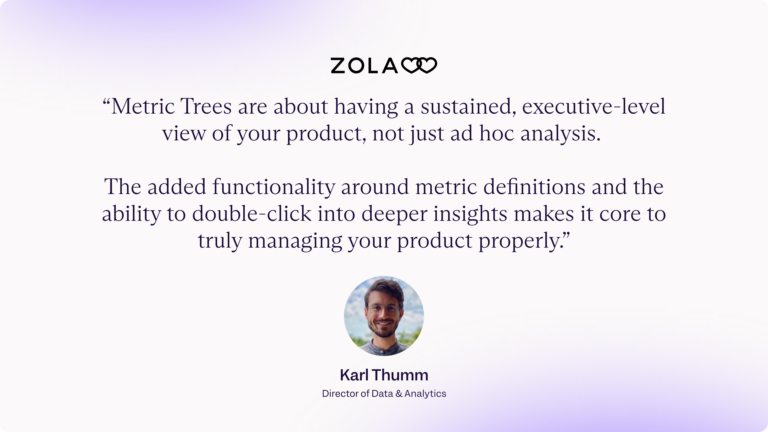
Metric trees are a powerful framework for making strategy explicit and actionable. When your growth model is clearly mapped, teams and the AI tools they use can operate with a better understanding of what actually drives outcomes.
Instead of fast but inaccurate reports, you get analysis tied to real growth levers and root cause discussions that reflect how your product actually works.
We see metric trees as the long-term foundation for more context-aware AI—systems that don’t just analyze raw data, but operate within your company’s strategic logic.
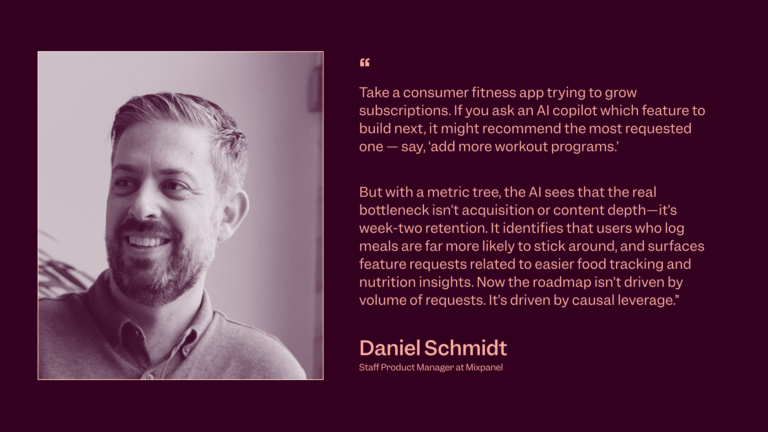
AI with added context (and human oversight) outperforms AI alone
AI is powerful, but it can’t define intent. Strategic judgment—deciding what matters and why—still belongs to humans.
Metric trees help make that judgment explicit. They align leadership, product, growth, and data teams around a shared view of how the business grows, and they reduce the risk of siloed decision-making.
When that alignment exists, AI becomes a force multiplier instead of a source of drift. Start getting real value from your AI initiatives and request a Metric Trees demo today.