
Product-led growth in 2026: A complete guide (and the metrics that actually matter)

Product-led growth uses your product as the primary driver of customer acquisition, activation, retention, and expansion. Unlike traditional sales-led approaches, PLG relies on users experiencing value directly through the product itself. Success requires sophisticated digital analytics to understand user behavior, optimize conversion funnels, and drive data-driven growth decisions.
Product-led growth (PLG) used to be the scrappy underdog strategy, or the approach startups used to grow without a proper sales team. Today, it's almost the default, with 58% of companies using a PLG model. Mixpanel's 2026 State of Digital Analytics report, which analyzed behavior across 12,000+ companies, named product as the new primary growth channel, with leading B2B companies now anchoring their growth strategy on in-product signals like feature adoption and time to value.
Despite widespread adoption, PLG programs don't always deliver on their promise. Many teams adopting PLG underestimate what it actually takes to execute, and measurement is almost always where we see teams struggle. It’s tempting to track signups and page views, but activation, product-qualified leads, and expansion revenue are higher-leverage metrics. The difference between PLG motions that compound and ones that stall comes down to whether you're watching the right signals and acting on them quickly enough.
This guide covers what product-led growth actually means in 2026, how the approach has evolved over the past two years, and what it takes to build a PLG motion that translates into durable revenue.
What is product-led growth?
Product-led growth is a go-to-market strategy where the product itself drives customer acquisition, activation, retention, and expansion. Instead of relying on a traditional outbound sales process, PLG companies let users discover, try, and derive value from the product before ever talking to a salesperson.
Blake Bartlett at OpenView Venture Capital coined the term in 2016, but the underlying mechanics, such as freemium models, self-service onboarding, viral sharing loops, predate the label. What's changed is the sophistication of the execution.
Today, product-led growth rarely exists in isolation. Most successful PLG companies blend self-serve product experiences with targeted sales conversations at the right moments. That hybrid approach is increasingly referred to as product-led sales (PLS), and it's become the dominant model for high-growth B2B SaaS. More on that below.
“Sales often has a harder time buying in [to product-led growth] because they’re worried about their jobs. But once they do buy in, they realize it’s so much better because they can work on bigger deals that focus on deeper value realization and sophisticated use cases in your product. And if the product can at least somewhat sell itself, then sales isn’t starting from scratch on those deals.”
What's changed in PLG in 2026?
If you built your understanding of PLG from articles written in 2022 or 2023, a few things have genuinely shifted.
Unlimited freemium is dying
The "give everything away free and hope users convert" model has lost popularity. Slack, Notion, HubSpot, and Calendly have all tightened their free tiers in the past two years. What's replacing it is “strategic freemium,” or free tiers that create genuine value for free users while creating natural pressure to upgrade.
Product-led sales is now standard, not the exception
Pure self-serve PLG (where no human ever touches a customer) works at a narrow band of price points. For higher annual contract values, conversion rates can improve when a sales conversation happens at the right moment. The result is a hybrid motion where product analytics identify high-intent users (product-qualified leads, or PQLs), and sales teams engage them precisely when they're most likely to convert. At Mixpanel, we see this hybrid motion as the natural endpoint of PLG principles: product data doing the work of qualifying intent, so sales conversations happen with the right people at exactly the right moment
AI has changed what personalization means
In 2023, personalized onboarding meant showing users a welcome screen based on their job title. Now, it means the product uses behavioral signals, like which features a user explores first, where they pause, and what they skip, to adapt the experience in real time. AI-powered analytics make it possible to infer user intent from complex action sequences rather than from static attributes (a user clicked a “Contact Sales” or “Upgrade Now” button in the product).
Real-time analytics are now table stakes
The weekly reporting cycle that was standard five years ago doesn't support modern PLG experimentation. Teams running A/B tests on onboarding flows need to see results within hours, not days. This has moved the kind of user behavior analysis offered by product analytics-centered solutions like Mixpanel from a "nice to have" to core infrastructure for any company running a PLG motion.
“An online photo editing tool I worked with was struggling with low conversion rates for plan upgrades. They dug into Mixpanel and discovered that a particular email activation step was causing a whopping 27% of signups to not go into the product. By eliminating this step, they were able to dramatically increase time-to-value, and—long story short—people began upgrading in droves,”
Key characteristics of product-led growth
Strategic freemium and free trial models
Freemium and free trial models remain the entry point for most PLG motions: 75% of PLG companies use one or the other. The strategic questions teams face when designing free tiers are what to include and where to draw the line.
Strategic freemium works when the free experience is genuinely useful (enough that users build habits and invite teammates) but constrained enough that the value of upgrading is obvious. Message history limits, seat caps, and storage thresholds are common mechanisms. The goal is to make the free tier feel like a complete product, not a trial that's been artificially crippled.
Free trial models work differently. Opt-out trials (where billing information is collected upfront and users are charged unless they cancel) convert at nearly three times the rate of opt-in trials—48.8% versus 18.2% on average. Shorter trials also outperform longer ones: Trials of seven days or fewer convert at 40.4%, compared to 30.6% for trials over 61 days, again according to FirstPage Sage. Urgency matters more than extended evaluation time.
Self-service onboarding and activation
Activation, defined as the point where a user first experiences the core value of a product, is the highest-leverage moment in any PLG funnel. Everything after it (retention, expansion, virality) depends on users getting there.
Good self-service onboarding is designed around a specific "aha moment": the action or sequence of actions that reliably predicts long-term retention. The best PLG teams don't guess what that moment is; they measure it. Cohort analysis comparing activated versus non-activated users reveals the behavioral patterns that separate retained customers from churned ones.
In 2026, leading PLG companies have moved beyond templated onboarding. AI-driven personalization now adapts the onboarding sequence based on early behavioral signals, like what a user explores first, whether they invite teammates in the first session, and which feature they return to most. The goal is to get each user to their specific aha moment as quickly as possible, rather than walking everyone through the same generic checklist.
Viral growth mechanisms
The most efficient growth engine in PLG is a product that sells itself through use. Collaboration features, shareable outputs, referral programs, and network effects all create loops where existing users bring in new ones.
Calendly's growth is a simple example: Every time a user sends a scheduling link, a potential new user sees the product. Dropbox's referral program, which offers extra storage for inviting friends, turned its user base into a distribution channel. These mechanisms are designed into the product from the start, then measured and optimized like any other growth lever.
Viral coefficient (the number of new users each existing user generates) is the metric that captures this. A coefficient above one means the product is growing on its own. Most PLG products operate below one, but virality still meaningfully reduces customer acquisition cost.
Data-driven optimization
PLG teams treat the product as a growth experiment. Every onboarding step, paywall placement, and feature prompt is a hypothesis to be tested. The teams that compound fastest are the ones running the most experiments and closing the loop between data and decisions quickly.
This requires a specific kind of analytics infrastructure: event-based tracking that captures individual user actions (not just aggregate page views), real-time dashboards, and self-serve access for non-technical team members. The goal is to shrink the time between "something changed" and "we understand why and what to do next."
Benefits of product-led growth
Lower customer acquisition costs
Traditional sales-led growth is expensive. Sales development reps, account executives, and long sales cycles add costs to every new customer. PLG shifts the majority of acquisition cost to product development and infrastructure, costs that scale more favorably.
Expansion revenue, which is central to PLG, is particularly efficient. It costs less to generate revenue from existing customers than from new ones. PLG companies that build expansion loops into the product itself—features that surface natural upgrade moments—capture this advantage systematically.
Faster time-to-value
When users can try a product immediately, without scheduling a demo or going through procurement, the feedback loop accelerates. Users reach a verdict faster, which means the ones who are a good fit convert faster, and the ones who aren't leave without consuming significant sales resources.
Faster time-to-value also creates a natural filter. The users who make it through self-serve onboarding and convert are the ones who genuinely saw value in the product, and that correlates with better retention and higher lifetime value.
“We started thinking: ‘Okay, how do I make it easy for people to try? How do you make it easy for people to buy?’ That brought us to the buyer experience we have today, where the buyer can go to our website, they can trial our product, and they can get through 90% of everything that they need to do without talking to anybody within the organization."
Scalable growth without proportional headcount
When you scale a sales-led motion, you typically require more salespeople to do the work. PLG breaks that ratio. Once the product experience is built, it can serve thousands of users simultaneously without additional headcount.
That scalability doesn't mean PLG companies never hire sales. It means sales headcount is deployed at the moments where human conversation actually changes conversion outcomes, typically at higher contract values or when a PQL needs help navigating procurement.
Why some PLG initiatives fail (and what to do differently)
Many of the product teams that use Mixpanel run a product-led growth motion, so we’ve seen a lot of the common challenges up close. Here are the big PLG pitfalls we’ve helped our customers look out for.
Chasing activation without defining it
Teams launch PLG motions and track signups, but don’t rigorously identify what "activated" means for their product. Without a precise activation definition, backed by data showing which behaviors predict long-term retention, onboarding optimization is guesswork.
Building PLG on analytics that can't answer the right questions
Basic web analytics can tell you that something happened. They can't tell you why, who, or what to do next. PLG requires behavioral analytics that answer specific questions: At which onboarding steps are users dropping off? Which cohorts have the highest 30-day retention? What's the activation rate for users who tried a specific feature in their first session versus those who didn't?
Treating freemium as a permanent tier instead of a conversion mechanism
Some free users will never pay. That's fine; the important question is whether your freemium experience is creating the conditions for the right users to convert naturally, or whether it's consuming infrastructure and support costs without a clear upgrade path.
Product-led growth examples: Companies doing it right
AB Tasty’s success is proof of how product analytics support a PLG motion. By analyzing user behavior in detail, the team redesigned their product tour based on what actually drove activation, increasing product tour completion from 2% to 15% and free trial-to-PQL conversion from 0% to 20%. Read about how Mixpanel helped them get these results in our case study.
Figma grew through a combination of free collaborative access and a viral sharing mechanism—design files that non-users could view and comment on without signing up. By the time Adobe announced its acquisition attempt in 2022, Figma had become the default design platform for product teams, largely through PLG mechanics. Enterprise contracts followed the individual users who brought the product into their organizations.
Calendly built its entire user base on a viral loop baked into the core product. Every scheduling link sent to a non-user exposed Calendly to a potential new customer. The company reached 20 million users and a $3 billion valuation with a small team, almost entirely through this mechanism. Dropbox paired a freemium model with one of the most imitated referral programs in SaaS history—offering extra storage to both the referrer and the new user. The product's core value proposition (your files, everywhere) made the referral mechanism feel natural rather than transactional. Dropbox now generates $2.3 billion in annual revenue across 700 million users.
The analytics foundation: Why product-led growth needs deep data insights
PLG is only as good as the data that drives it. The companies that execute PLG well are as committed to measurement as they are to product management.
Essential product-led growth metrics
Activation rate is the percentage of new users who reach your defined activation milestone. It's the most important metric in a PLG funnel because everything downstream—retention, expansion, revenue—is a function of activation. Improving activation rate from 20% to 30% has the same top-line effect as a 50% increase in signup volume, at a fraction of the cost.
The formula for calculating activation rate is:
Activation Rate (%) = (Number of Users Who Performed Key Action / Total Number of New Users) * 100
Product-qualified leads (PQLs) are users who have reached a behavioral threshold that signals purchase intent, typically a combination of usage frequency, feature adoption depth, and engagement patterns. PQLs convert at higher rates than marketing-qualified leads. Defining, tracking, and routing PQLs to your sales team is one of the highest-ROI moves most PLG companies can make.
The formula for PQLs isn't universal; it depends on your product. But the general structure is: (frequency of use) + (breadth of feature adoption) + (engagement depth) above a defined threshold. Cohort analysis against conversion and retention data is how you validate that the definition is working.
Free-to-paid conversion rate varies significantly by model and price point. Understanding where your conversion rate sits, and which user behaviors predict conversion, is the foundation of any monetization optimization work.Viral coefficient measures how many new users each existing user generates. Track it by cohort to understand whether virality is improving as you add sharing features or referral mechanics. Even a coefficient well below one reduces effective CAC significantly over time.
Viral Coefficient (K) = Average Number of Invitations Sent per User × Referral Conversion Rate
Retention by activation cohort connects activation to long-term revenue. Users who reached your defined aha moment should retain at meaningfully higher rates than those who didn't. If the difference is small, your activation definition may be wrong. According to Mixpanel's 2026 State of Digital Analytics report, weekly retention for B2B products ranges from 44.6% to 77.9% globally, a gap wide enough that the difference between top- and bottom-quartile performers often comes down to activation quality, not product quality.
Expansion revenue rate captures growth within existing accounts: seat additions, tier upgrades, usage-based overages. For PLG companies, expansion is typically the most capital-efficient growth lever available. Track it by cohort and by product area to understand which features drive upgrade decisions.
Traditional web analytics weren't built to answer any of these questions; they're built around sessions and page views, not user behavior over time. PLG requires event-based analytics that track what individual users do across their entire lifecycle, from first signup through expansion.
How Mixpanel powers product-led growth success
PLG teams use Mixpanel for the same reason PLG itself works: self-serve access to the right data, without waiting for a data team to pull a report.
Self-serve analytics for PLG teams
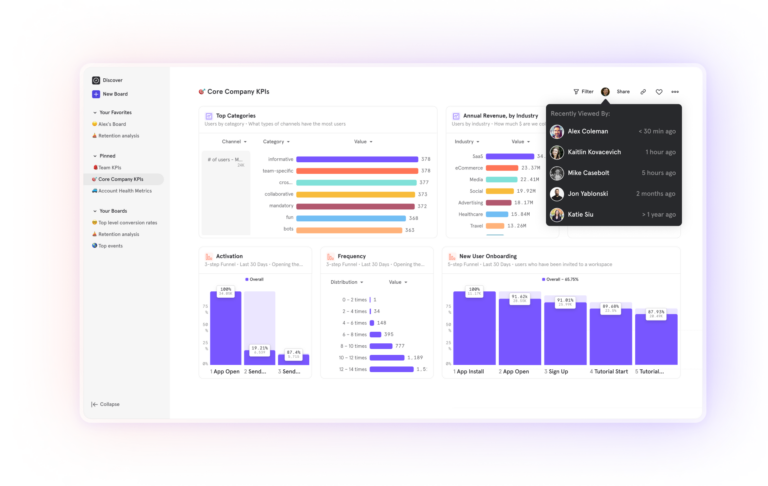
Product managers can build activation funnels, run cohort analysis, and measure the impact of onboarding changes without writing SQL or submitting a data request. Marketing teams can segment users by behavior, identify the cohorts most likely to convert, and tie campaign performance to downstream activation, not just clicks.
The practical result is faster iteration. When a team can answer a question in an afternoon instead of a week, they run more experiments. And in PLG, iteration speed is a meaningful competitive advantage.
Identifying and routing PQLs
Mixpanel's event-based tracking captures the behavioral signals that define a PQL: feature adoption sequences, usage frequency, and depth of engagement. Teams can build PQL definitions directly in the platform, set up alerts when users cross the threshold, and route those users to sales in real time.
This closes the gap between product data and sales action. Instead of sales teams working from a list of marketing leads, they're engaging with users who have already demonstrated intent inside the product.
Unified data and cross-functional alignment
One of the structural challenges in PLG is that product, marketing, and sales teams often look at different versions of the same data. Mixpanel creates a shared source of truth—the same events, the same definitions, the same metrics—so that when the product team says activation is at 28%, that's the same number sales is working from.
For B2B PLG motions, Mixpanel's account-level analytics extend this visibility to the team or workspace level, not just the individual user. Understanding which accounts have high activation rates and which have a single power user surrounded by inactive teammates is essential for prioritizing expansion outreach.
Product-led growth success starts with the right data
PLG is a powerful strategy. It's also one that punishes teams who can't measure it properly. The companies running the most effective PLG motions are obsessive about tracking the right signals, defining activation precisely, building PQL models, and acting on behavioral data in real time.
The shift from "we have a freemium tier" to "we have a product-led growth engine" comes down to measurement. What behaviors predict conversion? At which onboarding steps are users dropping off? Which free users are one good conversation away from becoming customers?
Those questions are answerable—if you have the right analytics foundation in place.