


How Metric Trees solve 4 common product manager problems

Product managers face a constant challenge: turning a flood of data into a focused growth strategy. Dashboards show results, but they rarely explain how each metric contributes to real business impact. Mixpanel Metric Trees change that equation by transforming data into a living map for growth.
With Metric Trees, every KPI, input, and experiment connects in one clear view revealing how actions translate into outcomes. The framework turns growth metrics into a dynamic system that evolves alongside your organization’s strategy, keeps teams aligned, and progress measurable. Instead of reacting to numbers, product teams can finally see how their decisions drive business growth forward.
Today, we’re going deeper on four common challenges we hear from product managers and how Metric Trees solve each one.
1. “Our metrics are messy.”
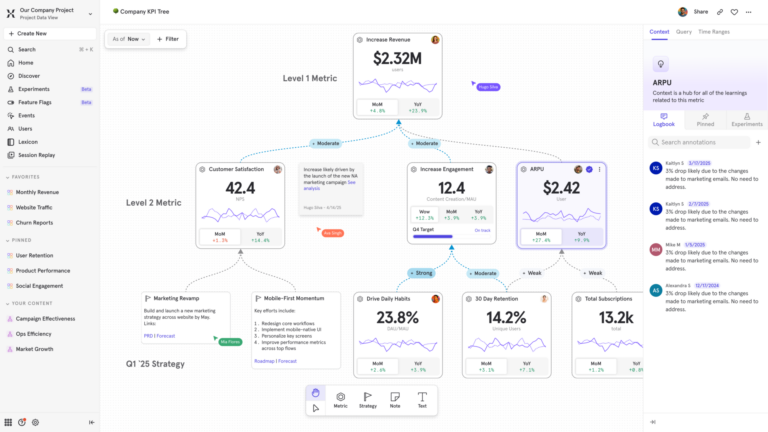
When metrics are scattered across dashboards, spreadsheets, and reports, it’s nearly impossible to see how they relate. Unlike traditional dashboards or static frameworks, Metric Trees organize growth metrics within a clear relational hierarchy, showing how each input contributes to strategic KPIs. This structure helps product teams rally around shared goals, track progress over time, and achieve true cause-and-effect understanding.
Messy metrics are often the root of a deeper issue that product teams articulate as “I don’t have one clear view on if our strategy is succeeding.” When foundational metrics lack structure, visibility into progress is fragmented. By mapping every metric in context, Metric Trees provide clarity and make it possible to understand how work connects to outcomes, which reveals what matters and what can be deprioritized. The visual hierarchy creates order out of chaos.
2. “We lack accountability for our metrics.”
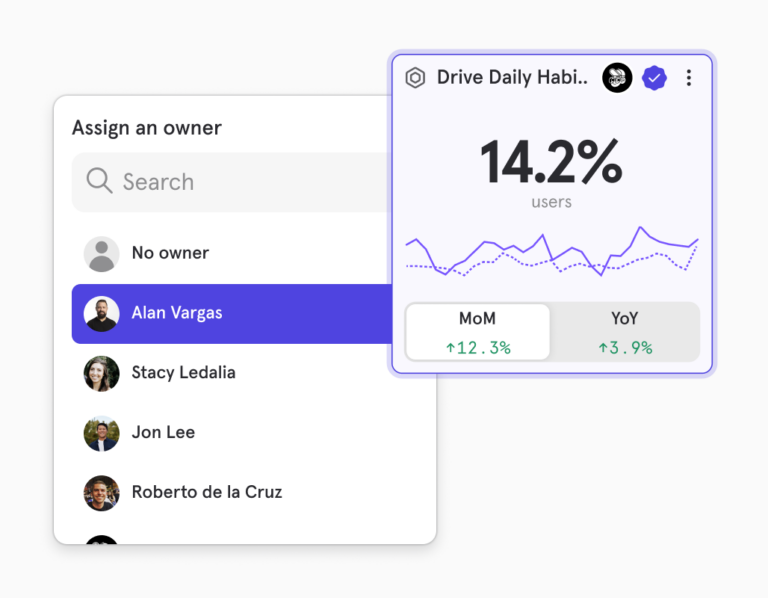
When teams don’t know who owns which metric, progress stalls. Metric Trees establish accountability by allowing teams to define and assign owners to every metric across the hierarchy. Each owner is responsible for monitoring performance, interpreting changes, and taking action when needed.
This approach inspires collaboration between teams while reinforcing shared responsibility for outcomes. By making ownership visible, Metric Trees help create a culture where every team understands how their work contributes to growth. Metric insights further enhance accountability by enabling teams to annotate metrics, log decisions, and document the reasoning behind every change.
3. “Our strategic frameworks are quickly outdated and rarely used.”
Traditional growth frameworks often lose relevance shortly after they’re created, becoming static artifacts instead of guiding decision-making. Metric Trees solve this by ensuring the framework evolves as the business evolves. As priorities shift or new initiatives emerge, the framework can be updated to reflect current strategy, which keeps teams grounded and continuously aligned with what matters most.
This adaptability keeps your strategic framework alive and relevant. Supported by Mixpanel’s advisory workshops and data planning programs, organizations can design and maintain a growth framework that stays current and useful.
💡 Pro tip: Visit this article to learn 10 additional Metric Trees benefits.
4. “We’re not sure what to prioritize with reports and boards.”
Many organizations try to solve their data needs by producing more dashboards and more metrics, but this usually leads to clutter instead of clarity. Dashboards pile up, attention scatters, and teams lose track of which numbers actually matter for driving growth.
Metric Trees cut through the noise by anchoring teams to a focused set of strategic growth metrics. Instead of chasing an ever‑expanding list of dashboards, organizations can rally around the handful of indicators that actually guide performance. This shift frees up data resources, sharpens decision-making, and helps teams invest energy where it produces real impact.
By spotlighting the metrics that matter, Metric Trees turn reporting from a maintenance burden into a strategic advantage.
“Dashboards show results. Metric Trees reveal how work creates outcomes—and that clarity changes everything.”
Bring strategy and management together with Metric Trees
Metric Trees bring structure to fragmented metrics by connecting them within a single coherent system. Executives see how initiatives influence outcomes, data leaders get consistency and alignment, and analysts and product managers can trace how each metric drives performance. The result is a more focused, faster-moving organization with a shared foundation for growth decisions.
Request a Mixpanel Metric Trees demo today.