

Introducing Mixpanel Headless: Programmatic product intelligence for AI agents

Product analytics work repeats: Reading dashboards, updating cohorts, rolling out feature flags, writing post-launch retros. Most of it is exactly the work an AI agent can handle—if the agent has something real to act through.
Until now, that surface didn't exist for Mixpanel. Today it does.
Mixpanel Headless is a full Python SDK for Mixpanel itself that makes it possible to read and drive everything in the product from code. Every report, cohort, funnel, retention curve, dashboard, feature flag, and experiment is now a typed Python object, ready for whatever you—or your agent—wants to do with it.
What's already possible, and where it stops
Earlier this year we shipped a Model Context Protocol (MCP) server that exposes Mixpanel to AI clients like Claude, Cursor, and ChatGPT. It's a curated set of about 30 tools designed for natural-language sessions where you ask a question and get an answer.
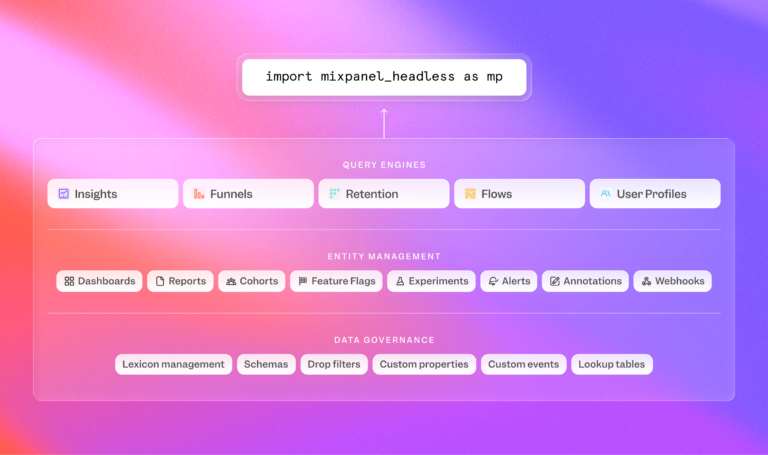
It works well for that. The limits show up when you want an agent to do real work. The tools are a fixed menu, so anything outside it is off the table. The agent decides which tools to call while it's running, so the chain of calls varies from run to run. That's fine when a person is in the loop reviewing each answer. It's the wrong shape for a system you want to leave running.
Agents that do real work need the whole product, not a slice of it. If you already use our MCP server for quick analysis and chat, keep using it. But Headless is what you reach for when you want an agent to work on its own.
Programmatic product intelligence
Most code written against Headless won't be written by a person.
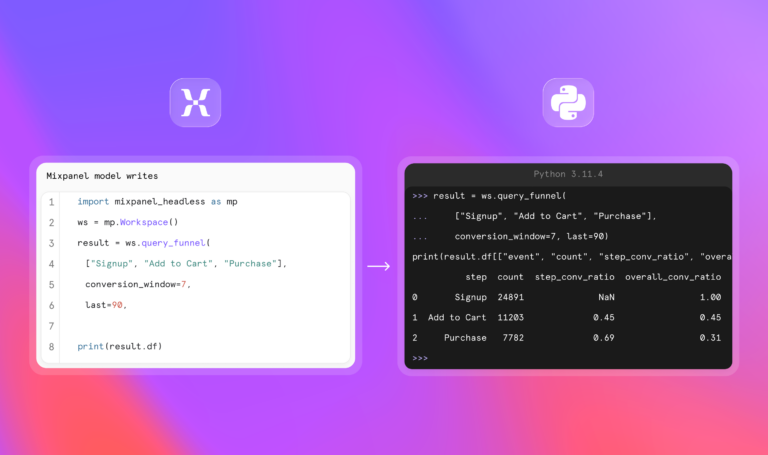
Here's what Claude produced when we asked it to watch week-4 retention and alert us if it dropped below 30%:
Watch week-4 retention and send me a Slack alert if it drops below 30%.
from mixpanel_headless import Workspace
import httpx

mp = Workspace()

result = mp.query_retention(
    born_event="Sign Up",
    return_event="Session Started",
    retention_unit="week",
    last=60,
)

# Bucket 4 = week 4 of the synthetic $average cohort
week_4 = result.average["rates"][4]

if week_4 < 0.30:
    httpx.post(
        "https://hooks.slack.com/services/YOUR/WEBHOOK/URL",
        json={"text": f"Week-4 retention dropped to {week_4:.1%}. Open Mixpanel."},
    )
A few seconds of agent time produces a script you can put on a cron schedule. The dashboard you used to check every Monday now checks itself.
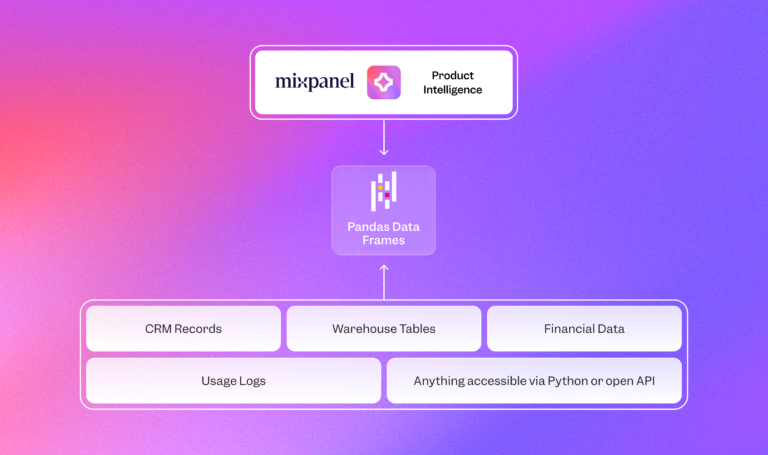
That pattern generalizes. An AI agent with Headless can hand cohorts to your CRM, feed product-usage anomalies to your LLM for deeper analysis, or pull funnel data into a DataFrame for custom reporting. Python connects everything. We don't need to build those integrations, and neither do you.
Now I go to Claude Code and say: we have a new event that went live ten minutes ago; build the dashboard like we did last time. Here’s the link to the previous one. About ten minutes later, I get a link to the new dashboard. I still check everything myself, even though I already know it’ll be fine.”
Continuous agent loops
The scripted version is the simple case. The interesting case is the agent that keeps going.
You describe what you want in plain language, Claude writes the script, and you can ship your flag without thinking about it again.
I'm shipping blog-demo-flag tonight and don't want to babysit it. If the checkout funnel drops below 5% in the next day, disable the flag for me.
"""Don't babysit blog-demo-flag tonight. Watches the checkout funnel
for 24h and archives the flag if conversion drops below 5%.
"""
from mixpanel_headless import Workspace
import time

mp = Workspace()

# Find the flag
for flag in mp.list_feature_flags():
    if flag.key == "blog-demo-flag":
        checkout_flag = flag
        break

time.sleep(86400)

result = mp.query_funnel(
    ["Page View", "Add to Cart", "Purchase"],
    last=1,
)

if result.overall_conversion_rate < 0.05:
    mp.archive_feature_flag(checkout_flag.id)
    print(f"Archived at {result.overall_conversion_rate:.1%}.")
Skip the script entirely and the picture gets sharper. Tell an agent: "Our activation rate is sitting at 38%. Find out why and propose a fix." With Headless in its toolbelt, the agent:
- Queries the activation funnel and segments by acquisition source
- Notices that organic signups convert at 52% while paid social drops to 19%
- Pulls the underperforming cohort and runs a retention curve against the activation event
- Drafts a hypothesis about onboarding friction for paid users
- Opens a feature flag to test the fix
None of that requires anyone to write code. It requires the agent to be able to do everything you'd do in Mixpanel.
That's the version of product analytics we want to live in.
Why a code surface matters
Agents change fast. Models get smarter every few months and the frameworks built around them change faster still. The thing that doesn't change is the contract underneath: a typed Python call to mp.query_funnel(...) returns the same shape today and a year from now. Whoever runs the code—human or model—gets the same answer for the same inputs.
That gives you three things a chat-only interface can't match.
Reproducible. The same script tomorrow produces the same answer. Put it on a cron schedule and the same process runs every day, with no manual check-in required.
Auditable. The code is right there. You can read it, review it, and decide whether to trust it before you let it run.
Deterministic in execution. Even when the agent that wrote the code isn't deterministic in its reasoning, the code itself runs the same way every time. That separation is what makes it safe to let the loops keep going.
Today, agents are teammates in how products get built, and they need an interface designed for how they actually work, not a UI built for humans. That’s Mixpanel Headless. It’s perfect for building real agentic flows that need to be scheduled, repeatable, and composed with other systems.”
Getting started
Mixpanel Headless is launching now in early access. Request an invite here.