


2026 Mobile gaming benchmarks: What the data tells us

Every player knows the pull of the daily login bonus or the limited-time event. This fundamental desire for rewards and progress is the engine behind the mobile gaming industry’s massive scale. Following the release of our 2026 State of Digital Analytics report, we’re sharing the data driving the mobile gaming sector.
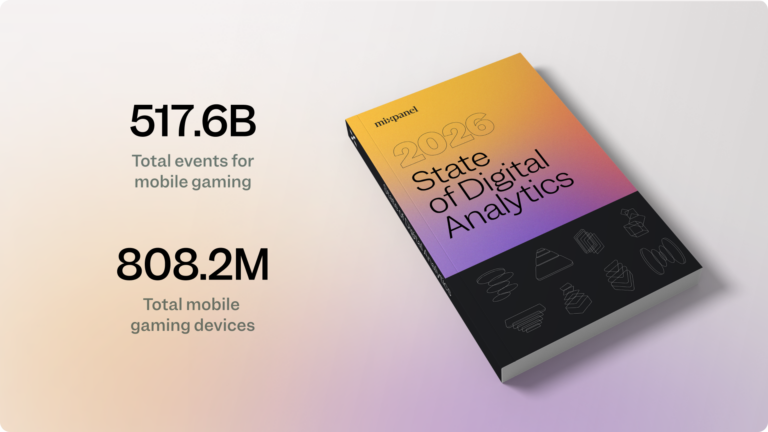
The industry is powered by a "personalization flywheel" where digital analytics transform gameplay patterns into measurable growth. With 517.6 billion total events recorded across 808.2 million devices, the scale of the opportunity has never been larger.
Global acquisition: Growth deepens in key markets
The data shows a transition in acquisition. Developers prioritize high-value player optimization over broad-reach tactics. This trend is particularly evident in the rise of hybrid-casual and mid-core genres that lean heavily on in-app purchases (IAP). Noteworthy highlights include:
- North America leads in scale. With 483.1 million in overall acquisition volume, it remains the primary market for high-LTV player bases.
- EMEA’s the region to watch. While second in total volume (181.1 million), EMEA saw a staggering 50% YoY growth, signaling a massive untapped revenue opportunity.
- LATAM’s trending down. A 30% YoY decline in acquisition suggests a tightening market where developers are finding it harder to find the right audience fit.
Key takeaway
Don’t chase raw installs as developers are increasingly adopting a model where initial conversion rates and "Time to First Purchase" are some of the few remaining metrics that matter for sustainable growth.
Engagement and LiveOps: The new competitive moat
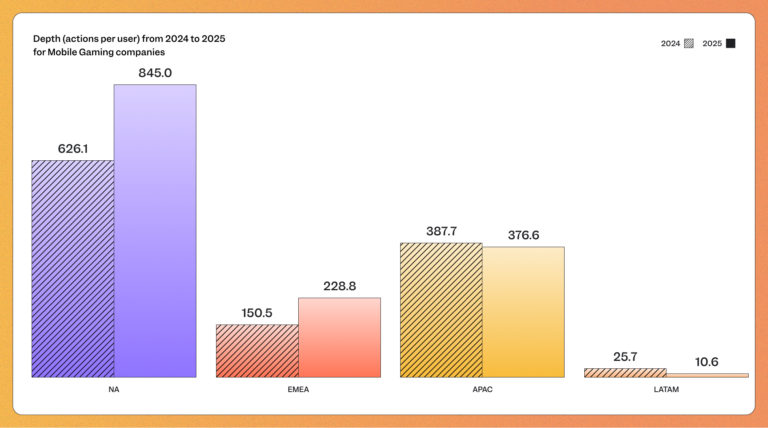
Engagement is a fluid metric as it’s the result of aggressive LiveOps and high-density content cycles. Players do more in-game than ever before, with overall actions per player reaching 642.2 (+30% YoY). From the report, we see the following:
- A new engagement benchmark. North American players lead all regions with 845 actions per player, a 35% increase from last year.
- The LiveOps effect in EMEA. Engagement in EMEA soared by 52%, a direct result of frequent in-game events and content refreshes that keep players active.
- LATAM’s localization gap. The region saw engagement collapse by 59% suggesting that generic content fails to establish the deep habits required for mid-core success.
Key takeaway
High-density content cycles are often the primary drivers of player actions. Frontier developers use AI to dynamically tailor content difficulty based on player performance to keep engagement high without inducing burnout.
Player stickiness: Establishing daily habits
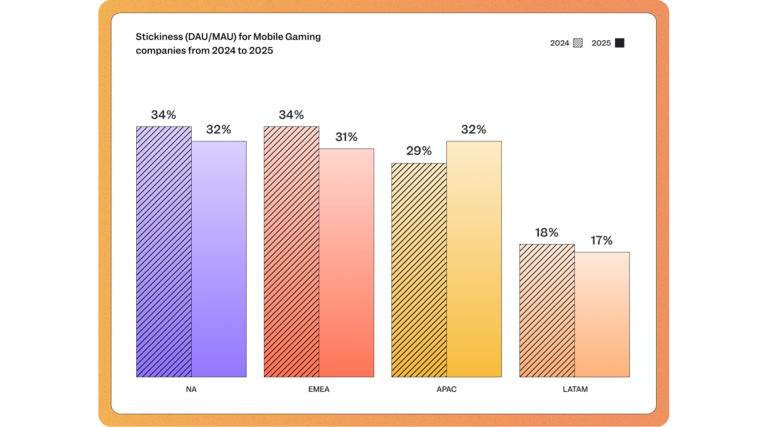
Measured by DAU/MAU, stickiness shows where players actually form reliable habits. While weekly players are abundant, turning them into daily participants remains the industry’s "maturity ceiling." Some callouts from the report show:
- Stability in mature markets. Stickiness in APAC and North America has leveled off at 32%. This ceiling could be a result of weekly players struggling to become more frequent users without significant social or reward-based incentives.
- LATAM continues to struggle. Lower stickiness in this region is likely a direct consequence of product and content mismatch, which reduces player commitment across the entire funnel.
Key takeaway
Encouraging daily habits is the next frontier for game developers. More and more providers are experimenting with socially triggered notifications, like friend gifts, to leverage social obligation and boost daily interaction rates. Time will tell if these efforts pay off for higher stickiness.
Retention: Closing the churn gap
Retention data highlights the massive difference between a successful launch and a sustainable game. The contrast between regions shows how much technical performance and early-game "social loops" matter.
- APAC's mobile-first dominance. One-week retention in APAC grew by 86% YoY. This surge was amplified by fine-tuning the early-game social habit loop to keep players coming back after first installing the game.
- LATAM can’t catch a break. Their 53% critical drop in one-week retention suggests that poor technical performance and slow content updates cause players to churn almost immediately.
- The weekly retention benchmark. While some regions struggle, APAC’s 92% weekly retention set a high bar for the rest of the world, well above second place North America at 79%.
Key takeaway
Technical performance and regional friction can’t be overlooked when aiming to raise retention. Among other reasons, it’s recommended that developers use behavioral analytics to identify and resolve Churn-Correlated Friction (CCF) before players leave for good.
Looking ahead: Player-centric growth
Mobile gaming studio leaders treat analytics as a real-time feedback loop, not an end-of-quarter report. The 2026 benchmarks make it clear that the quality of decisions being made between player sessions determines success or performance dips.
Personalization, LiveOps testing, and behavioral segmentation are table stakes and the pressing question is whether your team has the data infrastructure to act on them before a player churns, a region stalls, or a competing game figures it out first.The data’s already there and the studios that use it win. The ones that don't are handing those players to someone else.
Download the full 2026 State of Digital Analytics report to see how your game stacks up across regions and industries.