


From McKinsey to Mixpanel: A personal journey of problem solving and AI Automation

When I look back at my career—from my early days at McKinsey to leading initiatives across companies big and small, and now at Mixpanel—one theme stands out: solving big problems has always been about structure, hypotheses, data, and people.
The power of structured problem solving
McKinsey’s culture strongly encourages the discipline of breaking down seemingly nebulous business challenges into structured pieces. No matter how messy the situation—whether it was a multi-billion-dollar transformation, a market entry strategy, or an operational turnaround—four principles always applied:
- Structure the problem clearly so everyone knew what we were solving
- Form hypotheses to drive focus and momentum
- Ground every answer in data
- Assign ownership to talented people who could move the work forward
Part of my job leading consulting teams back then was to make all this happen with our clients to deliver outcomes. But this approach isn’t just consulting methodology. It became a life lesson for me, and people who’ve worked with me over the years. It’s how progress actually happens.
Using Metric Trees to establish shared context and focus
At VMware and every company since, tackling important company-wide initiatives ultimately came down to the same ingredients. Examples have included company-level competitive strategies or product GTM transformations.
For more quantitative initiatives, we can build Metric Trees to tie the ultimate goal (e.g., improving margins) to the workstreams that drive the input metrics (e.g., cost to serve, ASP, CAC). Each input metric has dedicated owners, objectives, and strategies.
While this approach accelerates time to impact by empowering teams, organizations can also spend a tremendous amount of time hypothesizing and debating which structure works best.
Accelerating problem solving with contextualized AI automation
That’s why I’m excited to share AI-generated Metric Trees. Simply by providing some context on your project or business, Mixpanel Contextualized AI auto-generates Metric Trees and recommended plays to help you achieve your objectives.
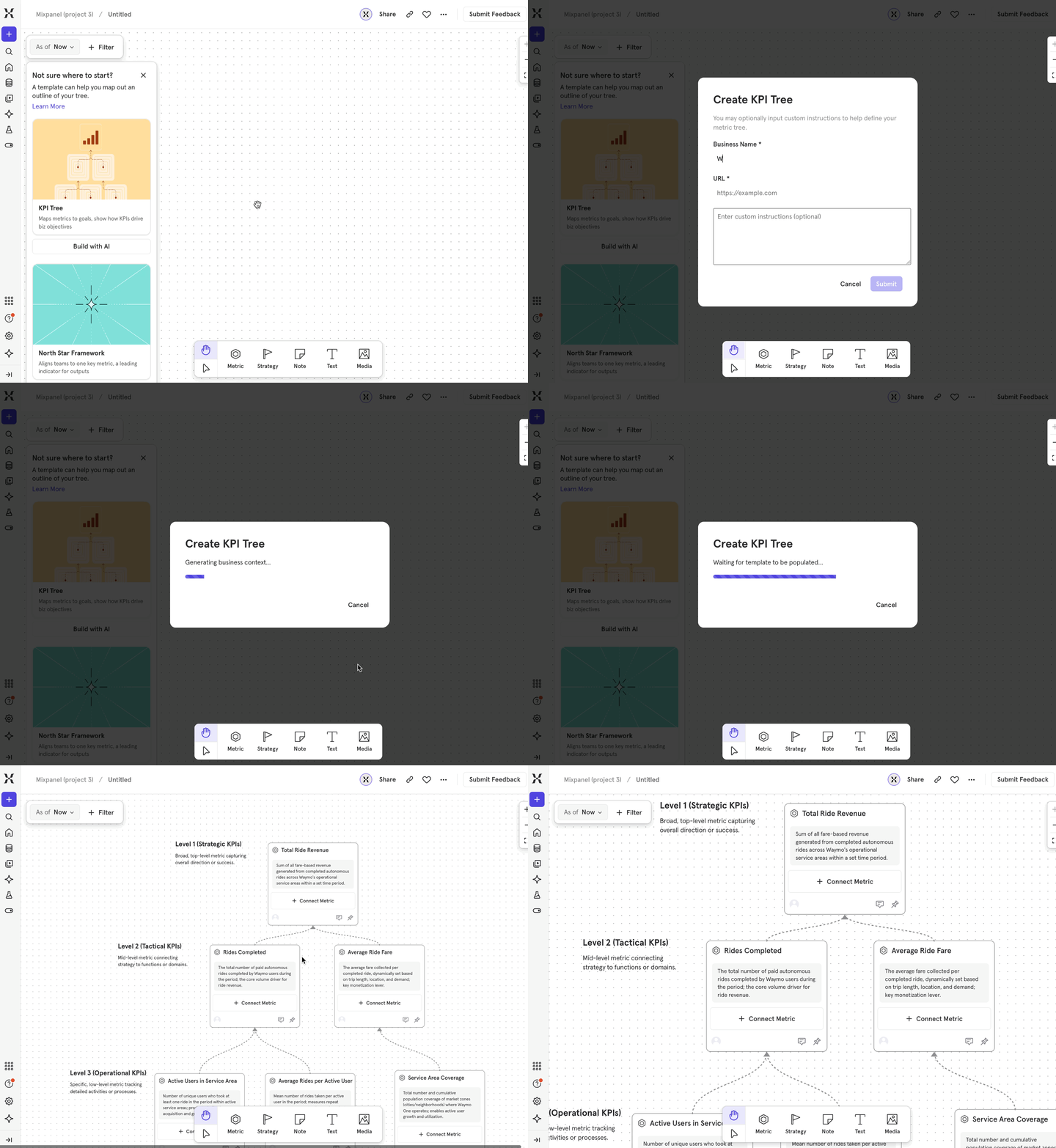
People own the product, with Mixpanel Contextualized AI a problem-solving partner. This turns the “McKinsey playbook” into living, breathing software that every team can use daily.
- Metric trees help every team member align on North Star and input metrics, along with ownership
- The Metric Tree is always a live reflection of product performance, and never needs updating after initial instrumentation
- Product managers can deep-dive into any metric in the tree, and perform analysis or watch session replays of key moments, highlighted by AI
- Any experiment (active or historical) is accessible from every node in the Metric Tree
- Real-world events (e.g., marketing campaigns, product changes) can be annotated so any metric change can be viewed in context
Many companies today do each of the above in pieces, across spreadsheets and multiple tools. Now with Mixpanel, all of this can be done seamlessly in one platform, with AI automation.
➡️ If you’re interested in joining our beta on AI-generated Metric Trees, sign up here.
Why this matters
Despite all the clickbait, I don’t think anything is going to “kill McKinsey” in the near future. They’ll continue to evolve, and there will always be a place for high-end advisory. But what Mixpanel enables is a new level of shared context, fact-based collaboration, and AI-powered productivity.
It’s about giving every team the ability to work from ground truth. It’s about accelerating how quickly companies can learn, adapt, and deliver positive experiences to customers. And ultimately, it’s about creating greater value exchange between companies and their users.
So, for me, the journey from McKinsey to Mixpanel isn’t a shift in philosophy. It’s a continuation. The same structured, hypothesis-driven, people-powered approach—just scaled and automated in ways we couldn’t have imagined back then.