
Vibe coding analytics: How AI-assisted builders use data to catch errors and stay on track

Vibe coding has gone from viral tweet to standard practice in the span of a little over a year—and it's still picking up speed.
What is vibe coding? It's the practice of building software by describing what you want in plain language to an AI coding agent and letting it write the code—no engineering background required. What's changed since the term first went viral is that the tools have gotten dramatically more capable, the community has grown, and the projects being shipped have gotten meaningfully more complex.
AI can't build everything, but it's opened doors for plenty of people who would have been shut out just a couple of years ago. And for builders who want their vibe-coded products to actually perform, vibe coding analytics—using real data to validate, guide, and improve what AI builds—has become just as important as the building itself.

We reached out to a few of these vibe coders to find out more about their methods, what they're building, and what they have to offer as best tips and tricks for others curious to get started.
One common refrain: Adding solid analytics to your vibe-powered development process can help you catch errors faster and keep your products on the right track.
Here's more on the rise of vibe coding and how the builders using it are staying data-driven.
The origins of vibe coding
In February 2025, OpenAI co-founder Andrej Karpathy posted a tweet that racked up over 5 million views: "There's a new kind of coding I call 'vibe coding', where you fully give in to the vibes, embrace exponentials, and forget that the code even exists. It's possible because the LLMs … are getting too good."
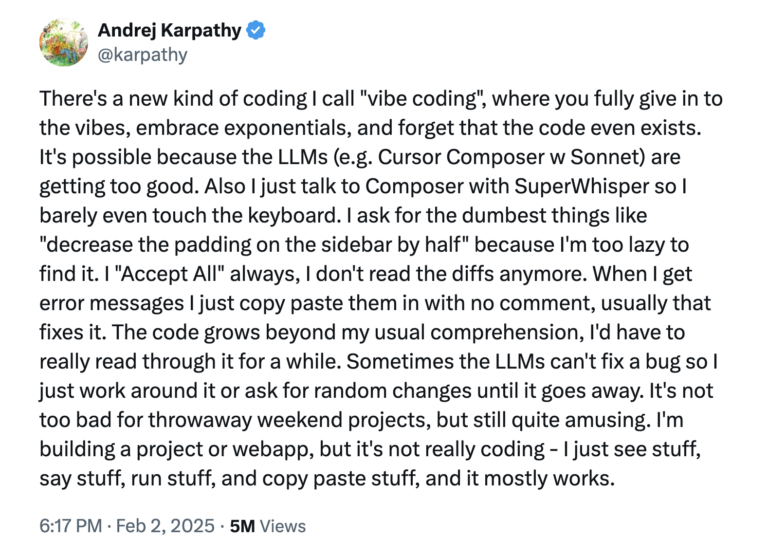
The idea—building software by prompting AI with natural language, without writing a single line of code yourself—caught fire almost immediately. Karpathy coined the term, but the technology had been quietly maturing for years: AI coding assistants like Cursor and GitHub Copilot had already been lowering the bar for building software, and the arrival of vibe coding gave the movement a name and a face.
Since that tweet, the tools have gotten considerably more capable and the projects more ambitious. So how are the potentials (and limitations) of this way of building actually playing out?
“Like looking over a developer’s shoulder”
For the vibe coders we spoke to, these new technologies have made it possible to harness their imagination, without the technical constraints that would have held them back even a few years ago. With AI taking care of the technical nitty-gritty, vibe coding lets them focus on the outcome they want rather than the lines of code that will allow them to get there.
"This approach isn't just about using AI to generate code; it's about creating a human-machine collaboration model that lets developers focus on creativity and product vision rather than getting stuck in coding or debugging tasks," is how vibe coder and Twittershots founder Kevin Wu described it to us.
At its best, vibe coding can help builders save hours of work that it would normally take themself or a hired dev or agency to create a new app, software feature, or website.
This approach isn’t just about using AI to generate code; it’s about creating a human-machine collaboration model that lets developers focus on creativity and product vision rather than getting stuck in coding or debugging tasks.”

"Vibe coding lets you chase these sparks of ideas. In the past, we would storyboard, create lo-fi mockups, then hi-fi designs, turn it into a working prototype, then get developer feedback, and likely iterate," said William Sayer, UX designer and vibe coder building Takeaways. "Now, adding this new idea or feature to the product is potentially just one or two prompts away."
Raymmar Tirado described vibe coding as fulfilling his lifelong dream of "looking over a developer's shoulder" and giving them instructions on what to do next. Most recently, he's used Replit's AI agent to build a global tracking widget for his Webflow cloneables (Webflow websites that can be cloned and customized). The widget allows him to add a universal call-to-action and manage the offer from a single dashboard while tracking traffic and campaign performance across the entire network.
The reality check: Common vibe coding mistakes and security risks
So far, the picture painted of vibe coding is pretty one-dimensionally rosy: Save tons of hours, hundreds or maybe even thousands of dollars, and make all of your wild ideas come true, without any dev support? Sign me up, please.
But (and of course there's a but), vibe coding still has real development gaps, including some that can cause serious technical issues or setbacks if you don't know what to look out for.
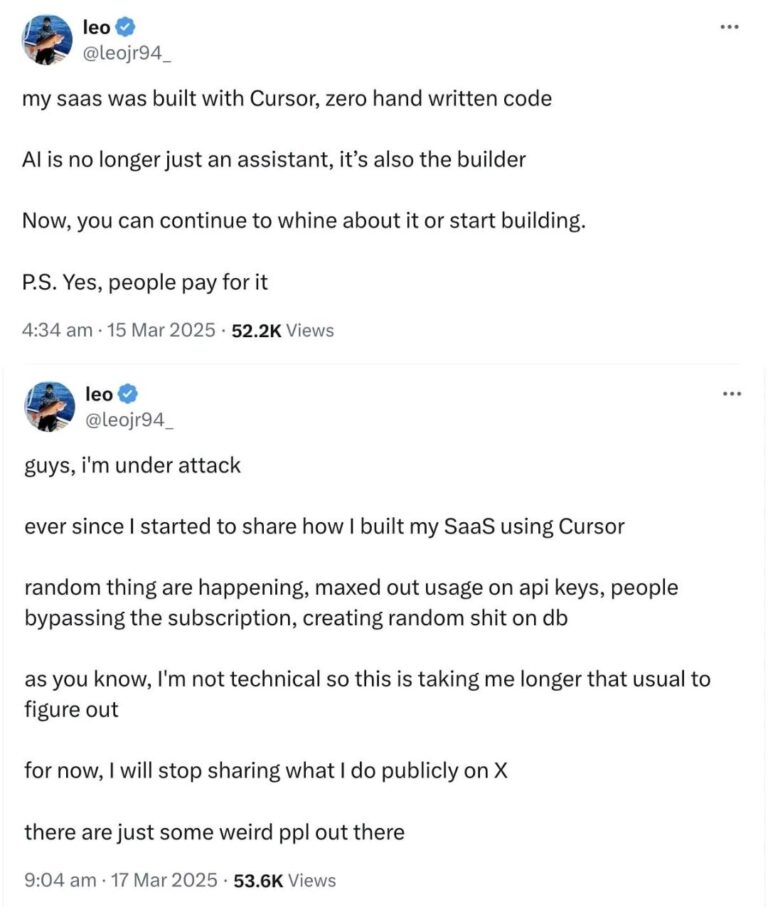
One well-documented concern is security. If an AI agent has a simple directive to build something, there's no guarantee it won't leak secrets like API keys or confidential information in the code itself, giving anyone access to your back end.
"When you're vibe coding, it's hard to tell if that's happening unless you review the code," warned Micah Allen, Mixpanel Senior Software Engineer. "I've had friends ask me to review things they've vibe coded recently. In one instance, I was able to use the information he published and log into his admin account."
Before you ship anything vibe-coded, ask your AI client to audit the code explicitly for exposed credentials, hardcoded API keys, and insecure environment variables. Make it part of your pre-launch checklist—the AI that built it can usually spot what it left behind.
Different AI tools require different levels of technical expertise, and the platform you choose matters. For more experienced builders, tools like Cursor AI or VS Code are a good choice. For complete novices, a platform like Replit might make more sense. "There are a lot of things that come along with doing development work that most people don't think about, like standing up the server and secure environmentals," Raymmar said. "Picking the right AI tool makes a big difference."
No matter what AI co-pilot you choose, both Raymmar and William agree that it's important to have an idea of what the AI is doing and to check its suggestions. "Most of the time it makes great suggestions, but maybe 10% of the time it will suggest something that it shouldn't do," Will said. "Every time it cooks something up, I go through to make sure I understand what it's doing to the code."
And if he doesn't understand, he can ask the AI itself to explain. "When I don't know, I can copy and paste that line into a chat and ask the AI to break it down for me. Vibe coding is so much faster than coding manually, but slowing down a little bit to understand what's happening is really important."
Common vibe coding pitfalls—and how analytics catches them
Most mistakes aren’t code bugs. They’re product missteps that data surfaces first.
| Pitfall | What goes wrong | How analytics catches it |
|---|---|---|
| Exposed credentials in code | Anyone can access your back end or admin account | Pre-ship AI code audit; anomalous access patterns surface in session data |
| Building for the wrong user segment | Features miss who’s actually using your product | User segmentation reports reveal your true audience breakdown |
| Prompt scope creep | AI builds something bloated or off-spec; real users get lost | Funnel analysis shows exactly where users drop off in the actual flow |
| Inconsistent property naming | Silently broken data; filters and groupings return wrong results | Lexicon flags duplicate or inconsistently named properties before they compound |
| “It works” ≠ “users use it” | A technically functional feature nobody actually engages with | Retention and event frequency reports show real usage vs. assumed usage |
| A/B testing on gut feel | You ship the wrong variant with no way to know | Event tracking on both variants gives real preference data |
Vibe coding best practices: Build small, iterate fast
Another common vibe coding mistake is trying to build something complicated with a single prompt. "I start with the smallest piece I can get working and then build out from there," Raymmar said. "Most people will have this assumption that they can tell the AI 'build Airbnb,' and it's going to one-shot the whole application. And that's almost never the case."
Taking the time to chat with the AI before starting, giving it some context, working out your requirements, and refining your prompts can save you a lot of time and effort down the line. "The more precise you can be, the better the output is going to be," Raymmar added.
I start with the smallest piece I can get working and then build out from there. Most people will have this assumption that they can tell the AI ‘build Airbnb,’ and it’s going to one-shot the whole application. And that’s almost never the case.”

Something else that doesn't work: trying to "talk the AI into fixing a mistake." If something isn't working, don't be afraid to roll it back and try again. "Saving your progress along the way is important," Will explained, and so is patience with the process. "The technology is getting better and better. Don't burn yourself out and get frustrated. Even if there's something you might not be able to do now, wait and you might be able to do it in six months," he said.
How to use analytics in your vibe coding workflow
AI coding can easily create false confidence (who doesn't love the way ChatGPT showers us with compliments every time we ask a question?), but adding analytics to your vibe-coded project can serve as an important reality check.
Tools in Mixpanel like Session Replay and the plethora of quantitative reports enabled by event tracking give vibe coders the kind of granular insights into user behavior that can indicate whether the thing AI built for them is working or not.
For example, William started using Mixpanel on a large product he's been vibe coding for a client, which has hundreds of thousands of downloads. Before Mixpanel, both he and the client had been under the assumption that they were building for two main user groups and had mainly ignored what they assumed was a much smaller third segment.
"The minute we connected Mixpanel, we realized that instead of this segment representing around 10% of our users, it was actually closer to 40%, which is an absolute cosmic shift in our understanding of our users," William said. "That kicked us into gear and made us realize we couldn't ignore this large group. We've started adding features and filling gaps specifically for those users. We were just guessing before, but now we have the data to help us know we're making the right decisions."
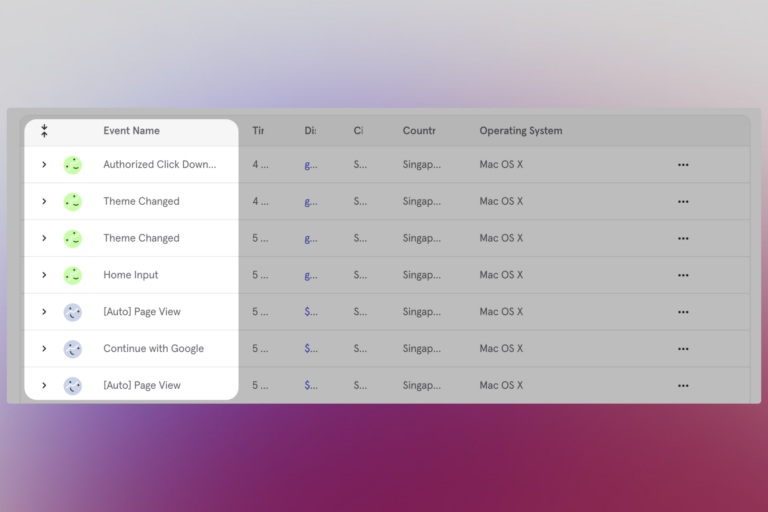
Kevin also shared several examples of how he uses Mixpanel while vibe coding TwitterShots: "I've integrated behavior tracking in my Twitter screenshot tool—from login, entering tweet links, theme selection, to using export or copy images. I check the user event flow daily to analyze completion rates and see exactly where users are abandoning the product."
He's also used the platform to analyze user demographics, leveraging the country/region options to identify that a large portion of his users came from the Middle East and North Africa. "Since they typically read right-to-left (RTL), I quickly shipped layout optimizations to accommodate this."
Finally, he uses Mixpanel for A/B testing. "Recently, I saw someone mention that adding Google login boosted their signup rates significantly. I'm A/B testing both approaches with real data by adding Mixpanel tracking to both buttons to see which one users prefer clicking," he said.
Mixpanel + vibe coding: A natural fit
A digital analytics platform like Mixpanel aligns very naturally with vibe coding.
What separates good vibe-coded apps from bad ones is actually listening to what users want. And that’s where a tool like Mixpanel comes in—it helps you understand your users.”

Part of that is simply Mixpanel's ease of use, with an intuitive user interface that makes self-serve analytics accessible to non-technical builders.
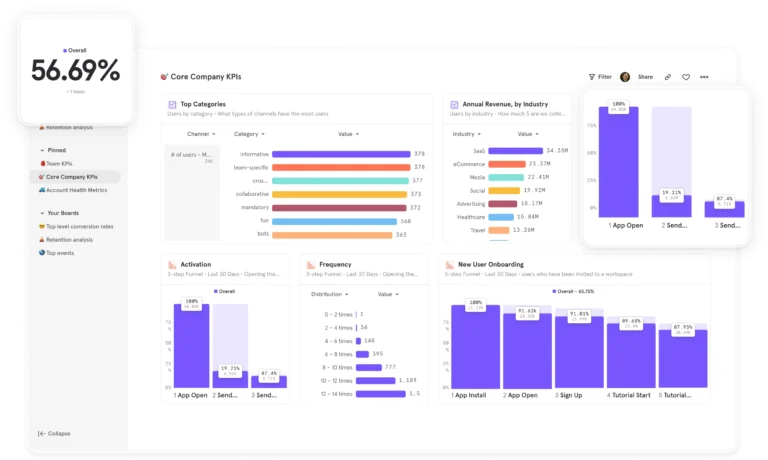
But another important factor is how accessible Mixpanel is for the AIs themselves. "Our documentation is super straightforward," Mixpanel's Micah Allen said. "AI models are trained on the internet, and that's where they get their information. Mixpanel is very easy to implement. If you ask an AI to implement tracking, it could do the whole job for you. There are a lot of third-party tools where that wouldn't be the case because they have a more complex setup or their documentation isn't as straightforward."
Vibe analyzing: Using AI for analytics too
AI is changing the game for software development, and it's making analytics easier than ever, too. The latest way to do it: the Mixpanel MCP server.
What is vibe analyzing? It's the practice of querying your product data using plain-language prompts to an AI client—no SQL, no dashboard navigation, no manual report-building. Describe what you want to know, and your AI client returns the answer.
MCP—short for Model Context Protocol—is the open standard that makes it possible. With the Mixpanel MCP server connected to an AI client like Claude, ChatGPT, Cursor, or Gemini, your AI can read your Mixpanel project—event schema, properties, the whole picture—and return full reports and Boards from a single prompt. It's the same "describe it, let AI handle it" philosophy that powers vibe coding, now applied to your product data.
Fittingly, the engineers who built the Mixpanel MCP server use it this way themselves. Ken Sherman and Gonzalo Lopez Bascur told us it's become core to how they develop and validate new Mixpanel features: Ken prompts an AI coding agent to investigate an issue, challenges its proposed fix, has it implement the change—then the same agent calls the MCP to verify the fix is reflected in the data. "You don't even need a human checking the dashboard manually," Gonzalo said.
Gonzalo has also used MCP to catch data quality issues that would have been easy to miss—like a property showing up as tool instead of tool_name, a quiet naming error with real downstream consequences for anyone filtering on that field. With MCP, it took a prompt to surface it. "If instead of saying the result in plain text, it shares a dashboard in Mixpanel which has the data that you trust—that's a lot more powerful," Gonzalo said. "I personally need the Mixpanel confirmation."
For vibe coders who are already asking AI to build their products, asking AI to analyze how those products are performing is a natural next step. Connect the Mixpanel MCP server to your AI client of choice and start getting answers where you already work.
FAQ: Vibe coding analytics
What is vibe coding? Vibe coding is the practice of building software by describing what you want in plain language to an AI coding agent—without writing code yourself. The AI generates the implementation; the human guides it with prompts and reviews the output.
What is vibe coding analytics? Vibe coding analytics is the practice of pairing a vibe-coded project with product analytics to validate that what the AI built actually works as intended, and to guide what to build next based on real user behavior rather than assumptions.
How do you catch errors in vibe coding? Errors in vibe-coded projects fall into two categories. Code errors—security vulnerabilities, exposed credentials, logic bugs—are best caught by having your AI client audit its own output before you ship. Product errors—building the wrong thing, for the wrong users—are caught with analytics. Event tracking, funnel analysis, and session replay show you how users actually behave, independent of what the AI assumed they would do.
What is vibe analyzing? Vibe analyzing is the practice of querying your product analytics using plain-language prompts to an AI client, without writing SQL or navigating dashboards manually. Tools like the Mixpanel MCP server make this possible by connecting your AI client directly to your Mixpanel data.
What is the Mixpanel MCP server? The Mixpanel MCP server is a Model Context Protocol integration that connects AI clients—including Claude, ChatGPT, Cursor, and Gemini—directly to your Mixpanel project. Ask a question about your data in plain language; get back full reports and Boards, inside the AI client you're already using.
You're still the builder
AI tools, vibe coding, and vibe analytics are opening up a new world of possibilities for creative builders and entrepreneurs. They no longer need to work with a developer or hire an agency to see an idea through—a few short hours and a couple of prompts can help them test initial viability.
The true differentiators are imagination, creativity, and building products that users actually want. "Product features are becoming easier and easier to make," William said. "What separates good vibe-coded apps from bad ones is actually listening to what users want. And that's where a tool like Mixpanel comes in—it helps you understand your users."
Explore Mixpanel and connect the MCP server to start vibe analyzing alongside your vibe coding workflow.