

How to build a company data culture: Tips from teams across Mixpanel

Data-driven company cultures don’t happen by accident. No CEO has ever waved a magic wand and magicked a new company culture into existence. If you want one, you have to create it intentionally, with support and alignment from all levels of the organization.
Here at Mixpanel, we think a lot about how companies can build a culture that puts data at the center and how those cultures can grow and thrive.
"There’s no correlation between the amount of data a company has and the strength of its data culture…a healthy data culture is one in which everyone is aligned on the outcomes you want to achieve and is clear about how to measure success."
Creating a functioning and actionable data culture doesn’t stop at product teams: It requires a company-wide shift.
We asked a handful of Mixpanelers—from technical and non-technical teams—for their tips on putting together a company data culture. Here are the biggest takeaways.
Lay a solid, simple data foundation
Trying to change culture can feel overwhelming for any company, from scrappy startups accustomed to operating on instinct to established enterprises navigating layers of approvals. That said, there are a few things that a company of any size can do to build a more data-driven culture.
For starters, you need a platform that helps you find, access, and analyze that data. If your growth team is looking at data in a marketing intelligence tool, your PMs are looking at a product analytics tool, your analytics team is getting data from the warehouse, and none of those numbers match up, you’ve got a problem.
Instead of building alignment, suddenly you have teams arguing about which data to trust, or you’re picking the one that looks best and hoping everything goes smoothly. Building a successful data culture means sharing a company-wide single source of truth and trusting those numbers.
To do that, you need a powerful analytics platform that you trust to create alignment around your shared data.
"Starting with a simple, scalable, and efficient data infrastructure from day one will make all the difference. Almost every organization is trying to embed data. In most cases, the roadblocks are bad data quality, struggling to find the data to use, having E2E data from different systems, or difficulties using the tools."
Once you have a solution for collecting and analyzing data (not surprisingly, all the Mixpanelers we spoke with recommend: Mixpanel), you need to know what data is important. In other words, what are the key metrics that indicate success for your business, and what are vanity metrics that you can ignore? Metric trees can help you understand how different metrics interact with and influence each other. In Mixpanel your trees are tied directly to live data, making it even easier to share insights across the company and help teams work together faster towards shared goals.
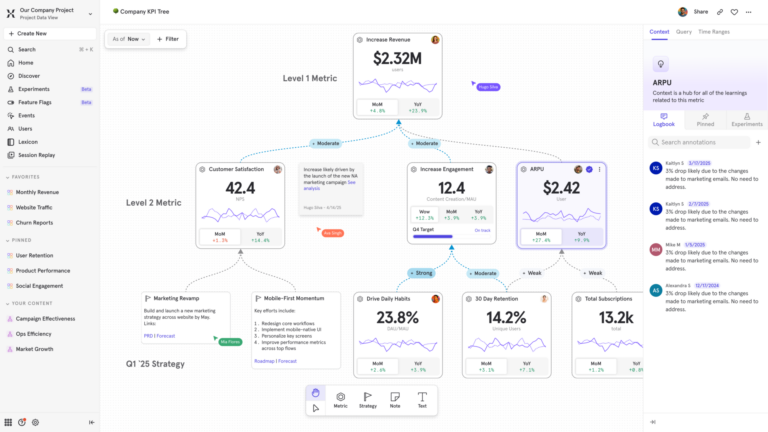
Perhaps most importantly, initiating culture change requires leadership buy-in. Leadership should be invested in the data, looking at dashboards, and even running their own experiments (or at least suggesting experiments and ideas based on the data they’re seeing). If the leadership team adopts a data-driven culture and leads by example, teams below them will have much more incentive to do the same.
Learn more about how Metric Trees in Mixpanel can turn your insights into action faster.
Get aligned behind the data
Some companies use data to validate decisions, and others use data and experimentation to guide their next steps. In either case, you want team members to agree on what data to use and how to use it. For Vijay, the key to alignment is putting the outcomes you want front and center.
Here’s more from his data culture blog:
At Mixpanel, our leadership team frequently asks ourselves and our team members two questions:
- What is the outcome we’re trying to achieve?
- How will we know when we’ve successfully achieved that outcome?
We’ve found that stating the outcomes we want to achieve is a force for aligning the company. Outcomes and data provide language to drive alignment.
Alightment like this requires a single source of truth and tools and processes for easily tapping into it. Features like Saved Metrics and Lexicon in Mixpanel ensure that definitions for data, events, user actions, and metrics are consistent and clear. Different teams can reuse the same shared definitions, ensuring accurate reporting and keeping everyone on the same page.
Mixpanel’s Director of Customer Success, Peishan Tan, recommends aligning around the key questions you want to answer before you start setting up tracking or diving into numbers:
"Start by identifying the specific questions that matter most to the business. Without that clarity, teams fall into the trap of trying to track everything ‘just in case.’ That leads to bloated instrumentation, slower execution, and a lot of time spent collecting data that may never be used."
Iterate quickly and fail forward
To build a data-driven culture, companies need to foster an experimentation environment. Teams need to ship fast and iterate quickly to avoid analysis paralysis. Continuous experimentation processes like the OADA Loop can help.
Sometimes, you’ll try something and not get the results you hoped for. And that’s ok! Even more importantly, sometimes that’s the whole point. By running the experiment and using the data, you get insights you wouldn’t otherwise have.
But if people are afraid to make mistakes, or if company culture is too focused on results instead of exploration, then your team is less likely to lean into the data and use it. In a data-driven culture, it’s ok to be wrong sometimes. The results matter less than the experimentation itself. When you simplify the testing process and celebrate learnings, not just wins, you create an environment where people are more likely to see data as valuable (and use it).
Getting people on board and aligned behind your data in the early stages of experimentation (so there are no surprises) is also a great way to keep everyone invested and prevent pushback later. One way to do that is by defining key metrics, as Senior Product Manager DJ Satoda says:
"We have our teams define a North Star metric that they're trying to drive at any given time and associate projects on the roadmap with that North Star metric. This helped our teams shift from checking dashboards to actually using data in daily decision-making."
Find out how Kolon Mall created a culture of experimentation thanks to Mixpanel’s Feature Flags.
Using data to foster empathy
Self-serve analytics frees up analysts to focus on deeper technical work instead of basic calculations. When access to data is democratized, your team members use self-serve analytics to look at data themselves instead of relying exclusively on what analysts send them. This gives them a more complete picture of how their work and their metrics impact your users, as well as other teams. If pulling one lever improves their KPIs but worsens someone else’s, it’s important to know that so they can improve collaboration.
Understanding how metrics impact your work and also that of other teams fosters empathy and shared understanding. It also helps break down the silos that many organizations struggle with.
Learn how Immobiliare built a data-informed culture and jumped their active rate among registered users from 20% to 80% in just over a year.
When culture shifts: From focusing on feature launches to measuring impact
Through the changes we’ve been working on at Mixpanel, we’ve learned that a data-driven culture changes how an organization makes decisions. Instead of shipping features and hoping they resonate, you focus on measuring what actually moves the needle. Teams start aligning around shared truth. Data becomes the language everyone speaks.
Building this culture is not about perfection. It's about starting with the foundations we've covered—a reliable analytics platform, clear definitions of success, space to experiment, and tools that make data accessible to everyone.
As Neha Nathan, Head of Enterprise Product at Mixpanel, shares: "I can run my own analysis without having to ask anyone if the data is tracked or checking that the data I'm using is correct because I can validate it myself." That's what a mature data culture feels like.
Your teams can reach that same place. Start small, stay consistent, and let data guide your decisions.