
5 macro trends shaping the future of digital analytics

Rising acquisition costs, fragmented user journeys, and mounting pressure to prove ROI are forcing teams to rethink what actually drives growth. Analytics has moved from simply observing what’s happening to engineering what should happen next.
Our 2026 Mixpanel State of Digital Analytics report looked at over 3.7 trillion events across 22 billion devices, analyzing results from 12,000+ companies to surface the most valuable insights across the analytics landscape. In doing so, we’ve uncovered fundamental shifts that product teams need to understand.
Trend 1: The rise of AI as a thought partner
AI has rapidly changed the way that users interact with technology. Instead of clicking around static dashboards, PMs and product professionals are increasingly using conversational AI co-pilots as the “front door” to their analytics setup. Asking copilots questions about their metrics in natural language allows teams to make connections they might not make without AI’s help.
Instead of manually building reports or spending hours reviewing data when conversions drop unexpectedly (for example), PMs can ask an AI copilot to do the same investigation in minutes.
This culminates in AI agents planning experiments, reallocating budgets, and automating entire workflows with minimal human intervention, though having a human in the loop for oversight and final validation remains crucial.
Industry applications
We’ve seen examples of this automation emerging across industries. In iGaming, for example, AI can promote product diversification (mini-games) during session lulls without human intervention. For B2B companies, AI can be used to automatically analyze granular usage data to spot early signs of disengagement and flag accounts that are at high risk of churning, enabling timely outreach.
Trend 2: Orchestrated customer journeys
Customer journeys are more complicated than ever: Users hop seamlessly between mobile apps, websites, and physical interactions, creating a mosaic of data that traditional measurement solutions can’t keep track of.
To counter this fragmentation, organizations are moving from simply observing and mapping historical behavior to proactively shaping what should happen next. They’re using advanced analytics and AI co-pilots to shape behavior by anticipating needs, personalizing experiences, and eliminating friction before it impacts product growth.
Industry applications
The State of Digital Analytics report highlights three different industry applications of this trend. For fintech companies, AI-augmented analytics are helping uncover confidence signals earlier than ever. Similarly, mobile gaming companies are using AI to dynamically tailor content difficulty based on players’ win/loss streaks. And AI-native companies are refining feedback loops to make their models smarter and anticipate user needs.
➡️ Download the full report to see more trends, complete data analysis, and key industry metrics to track.
Trend 3: Product as the primary growth channel
The report highlighted increased adoption of product-led growth, even in industries where that wasn’t previously the case. Instead of focusing on channel-specific models, more and more organizations are treating the product itself as the most critical channel for acquisition, engagement, and retention.
Because of this, understanding and optimizing in-product experiences is crucial to their growth strategies. Companies are focusing on in-product behavior like feature adoption and time to value (TTV) more than ever before.
Industry applications
Acquisition is expensive, and customer acquisition cost (CAC) is rising across regions and industries. To counter this, ecommerce brands in North America are shifting away from high-CAC channels to focus instead on existing customer retention and maximizing lifetime value, according to our report. Teams are using AI-powered strategies like hyperpersonalization to promote habit-building for repeat customers.
Similarly, one of the interesting findings of the report is the drop in engagement we’ve seen for AI companies in North America (-38% YoY). This isn’t necessarily a sign of poor stickiness. As people become more efficient AI users, they’re able to accomplish multi-step tasks with fewer interactions. Users aren’t interacting with AI less, they’re just being more efficient to reach their goals.
AI has made many tools dramatically more accessible, but it's also raised the bar. Users expect near-instant value, and their tolerance for friction or ambiguity has dropped accordingly.
Trend 4: Retention as the power metric
With acquisition costs rising and subscription fatigue reducing consumer spend, retention has become the most dependable driver of sustainable growth. Tracking, analyzing, and understanding what drives retention is the obvious first step.
Industry applications
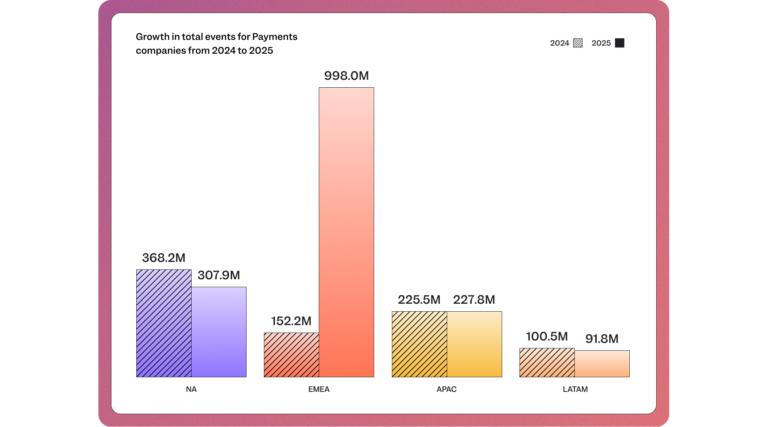
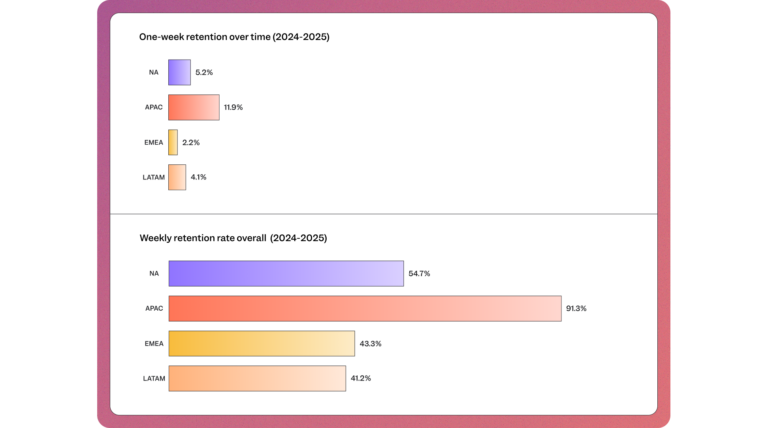
Our State of Digital Analytics report found that payment platforms in EMEA are seeing a massive influx of new users, but are struggling to retain them (-42.7% YoY). One of the ways to mitigate this churn is to implement two-step activation, which breaks down onboarding into smaller, higher-value steps and prevents overwhelm. Another is to use Churn Risk Scores (CRS) to drive a second, high-value transaction (like linking a utility bill) within 72 hours to drive value.
Trend 5: Composable tech stacks
AI has accelerated a restructuring of the analytics ecosystem that was arguably already underway. Economic pressure and increasing productivity demands are forcing consolidation around efficient, warehouse-native stacks. Teams are prioritizing solutions that offer a clear, complete view of user behavior.
Rigid CDPs with pre-integrated, single-vendor ecosystems are giving way to flexible, warehouse-native stacks with behavioral analytics at the center. As the self-serve hub for activating warehouse data, the analytics platform eliminates silos, reduces redundancy, and gives teams a single source of truth to build from. User behavior, not transactions, is what guides how companies operate and grow.
Industry applications
The shift to composable stacks is showing up differently across industries, but the underlying driver is the same: teams need to move faster.
In fintech, some data and engineering teams are replacing legacy CDPs with warehouse-native architectures that give them full control over how user data is stored, transformed, and queried. Instead of waiting on vendor roadmaps to surface the metrics they need, these teams connect their analytics platform (like Mixpanel) directly to their data warehouse and build the exact behavioral views their product and risk teams require.
For B2B companies, the composable approach is changing how product and data teams collaborate. Rather than routing every analytics question through a data analyst, product managers are querying behavioral data directly using natural language, a shift made possible by solutions like Mixpanel MCP (Model Context Protocol), which connects Mixpanel's platform to AI agents and removes the bottleneck of manual report-building.
In 2026, analytics goes beyond insight
What’s clear to us from these trends is that digital analytics is now more about future-oriented orchestration, and less about hindsight.
As AI becomes the interface and products the primary growth engine, moving quickly from insight to action will be a key differentiator. That means embracing AI as a thought partner, investing in retention over acquisition, and building flexible systems that can adapt as quickly as user behavior changes. Adopting these changes will help PMs understand their users better and empower them to act on that understanding faster than ever before.
Download the full State of Digital Analytics report to see more trends, to go deeper into the data, benchmark your metrics against industry peers, and learn more about strategies shaping the next era of analytics.