

How Mixpanel engineers use Feature Flags (and you can, too)

⭐ From running experiments to gradual rollouts, here’s how our engineering team uses Feature Flags every day.
When we launched Feature Flags, our teams were excited to explore Mixpanel’s newfound capabilities. We’d previously been juggling a mix of homegrown solutions and external tools to add and track feature flags.
Since the launch, we’ve been using Feature Flags to operationalize our experiments and validate new features before full rollouts. The results: Faster updates and streamlined continuous improvements.
Here are a few examples of how our engineers use Feature Flags.
Running experiments more easily
We recently used data to redesign our side nav, dogfooding our own Experiments and Feature Flag tools to try different variants and explore options.
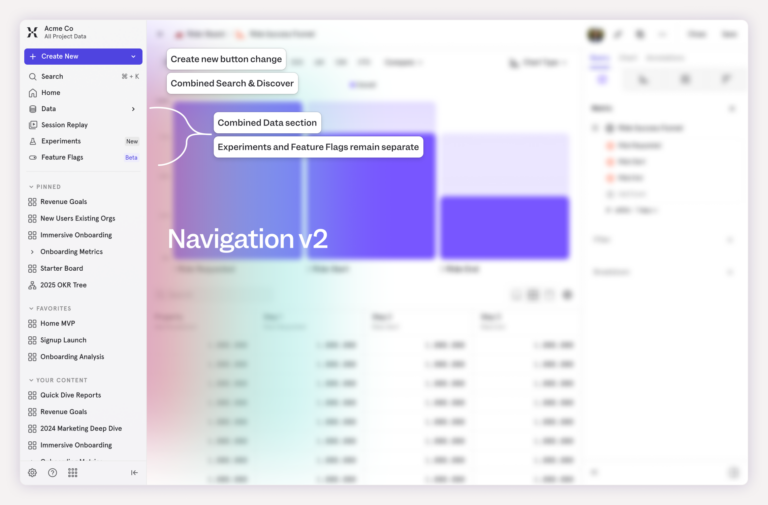
Feature Flags powered that experimentation process. Our engineering team added feature flag variants for each of the different nav combinations we wanted to test. The Experiment feature took care of the methodology, including ensuring statistical significance.
We’ve also updated Mixpanel’s date picker, a feature that allows users to choose the date range for the Board or Report they’re looking at.
We used Feature Flags to build two different variants. Then we ran an experiment to collect feedback and compare usage metrics for each option. The experiment showed a clear preference from users, which made it easy to pick the winning variant.
“The date picker is a critical piece of Mixpanel; it’s important to a lot of users and gets touched by a lot of people. Being able to specify the date range for a report is obviously very important, so we wanted to make sure we take this release slowly. We’re being very intentional and paying attention to all the feedback that comes in from customers as they receive this experience.”
Validating features gradually before a full rollout
Feature Flags allow us to roll out any new features or updates gradually to our users, limiting risks and giving us more space to test iterations. “We make updates and fine-tune it slightly to make the experience better for those users as we go,” Areeb says.
We used this approach with the date picker experiment mentioned above, rolling the change out to a small group of users, iterating on their feedback, and making small tweaks before rolling out to a slightly larger group.
By using Feature Flags to roll out features gradually, we can ensure that critical features like Mixpanel’s date picker remain functional for our customers, and quickly roll back any changes that affect performance or usability.
Making changes to features without rewriting code
One of the main advantages our engineering teams have experienced using Feature Flags is the ability to make changes to existing features behind a flag without needing to rewrite code. There is an initial code deployment required to put the feature behind the flag, but after that, updating it to bump the rollout from 10% to 20% or adding test users can be completed without any code change.
Feature Flags allow our engineers to make specific updates without writing and deploying new code, which saves significant amounts of time, even for a few lines of code.
“The process of deploying a code change always involves testing and stage deployments in a testing environment, and then in a product environment, and all that takes quite a bit of time,” Areeb says. “With the feature flag, you just flip a switch, and within a minute or so, it propagates to all of the different places it needs to. It skips a lot of the overhead of code deployment.”
The time-saving aspect is great, but the benefits don’t stop there:
“The ability to deploy and control changes is crucial in a fast development loop. We’re able to swiftly react to potential regression, or any negative impact an experiment could cause. This coupled with Experimentation, our engineers are instantly equipped with data-backed insights and can immediately take action to drive a continuous feedback loop.”
Coupling or decoupling front and back-end changes
Another engineering advantage of using Feature Flags is the ability to couple or decouple front and back-end changes, depending on your goals. With previous solutions, engineers had to make multiple code changes in different areas to get feature flags synced across the front and backend.
“We would have to change the percentage [of users] in multiple places,” according to Areeb. “That could get tricky, because we needed to ensure that the front-end and back-end changes had to go through simultaneously.” Now, code changes aren’t necessary, and any feature flag updates are automatically shared across the infrastructure.
Feature Flags: Beyond engineering
From our experience, there’s no doubt that Feature Flags make engineers’ lives easier. But they also go much further than that: Our PMs and designers have used them to optimize user flows, create personalized experiences for different cohorts, and optimize pricing strategies to maximize revenue without harming adoption.
Try Mixpanel Feature Flagging or request a demo today.