

Why I joined Mixpanel as CPO

Throughout my career, I’ve been driven by deep commitment to understanding customer problems. This started with an internship with the early Fullstory team, where I saw the magic of session replay. I remember experiencing for the first time the visceral understanding that comes from watching your users interact with your product in a completely different way than you’d intended and the addictive dopamine rush from using that understanding to make your product better.
That experience put me on a product management path, and I've been happily on it for the last decade. Now we've reached a pivotal moment for product builders: AI has made it possible to build almost anything, so the critical task is figuring out what's worth building. I believe that in another decade, we'll look back on this period as a turning point for product leaders. I also believe the future of software will be easy to use, full of delight, and focused on solving real problems for users, but this won’t happen automatically.
AI has made it possible to build almost anything, so the critical task is figuring out what's worth building.
That’s why I’m joining Mixpanel as CPO: to help teams understand how their products are actually used and make better decisions about what to build next.
How I got here
After that early internship, I went to SignifAI (part of New Relic), where we were building AIOps before it was cool. That experience gave me an appreciation for the technical sophistication required to power responsive, real-time analytics for applications with millions of users. A question that seemed straightforward—why is performance degrading?—actually required translation, interpretation, and analysis that pushed the limits of 2019-era tech. As a PM, my job was building tools that turned natural-language questions from SREs and DevOps teams into answers from messy, complicated data. It felt ironic that I was missing good tools to do that same translation for my own work.
At Cloudflare, I had the opportunity to build and run a product organization responsible for a fast-growing portfolio that powered critical infrastructure for a huge chunk of the Internet (yes, the Internet, with a capital “I”). I spent every day for years in the core tension of product management in the pre-AI world. We had a never-ending list of exciting ideas—brand new products, feature enhancements, performance and reliability improvements—with a finite number of design and engineering hours in the day. Drawing the “cut line” every planning cycle was painful and constrained by capacity more than conviction: Even if we knew our users had five problems, we could only address three because we could only write three solutions’ worth of code in a sprint.
And then, almost overnight, I watched this paradigm change. And, with it, so did the bottleneck in software development.
Choosing the right thing to build is the new bottleneck for growth
I watched firsthand as developers building new apps on Cloudflare (including our own engineering team) generated as much new code in a single afternoon as whole teams had in weeks before tools like Claude Code. AI coding agents have upended the entire software development cycle, which has transformed work for builders. Engineers can now prompt an army of agents to jam through their ticket queue and solve problems they never had time to before. Designers and product managers can use AI tools to prototype new ideas and ship fixes independently. The cost equation for deciding what goes on the roadmap has totally changed: In the world where my team could only fit three new features in a sprint, we had to make very sure those were the most important ones to build. But if we can now feasibly add our whole wishlist as to-dos in the same amount of time, why not?
Being a great builder in the AI era is only marginally about AI fluency and prototyping skill. The core ability is still exercising judgment about what to build, and it's more important than ever before.
The answer is obvious, but I’ve watched product managers struggle to remember it, and even more so now that AI is at their fingertips. I’ve definitely gotten carried away with the temptation to “Build All The Things” in my own vibe-coded apps! When you try to build everything for everyone, you end up with a terrible product that serves no one well, and the users that used to love you will abandon you for different tools that are easier to use and more specific to their problems. (And remember, building those competitive tools is easier than ever now.)
I believe being a great builder in the AI era is only marginally about AI fluency and prototyping skill. The core ability is still exercising judgment about what to build, and it’s more important than ever before. That judgment still comes from talking to customers directly to understand their problems, but also from understanding how they’re actually using the product.
| Before AI coding agents | After AI coding agents | |
|---|---|---|
| The constraint | The constraint | |
| Bottleneck | Writing enough code fast enough | Choosing the right thing to build |
| Limiting factor | Engineering capacity | Judgment and product taste |
| The roadmap | The roadmap | |
| Planning pressure | Only 3 features fit in a sprint—every cut was painful | Technically, you can build everything—so why not? |
| The real risk | Shipping too slowly | Building the wrong things fast |
| The skill that matters most | The skill that matters most | |
| Core ability | Execution speed and technical leverage | Exercising judgment about what to build |
| What earns trust | Shipping consistently and on time | Understanding users and deciding with conviction |
I want to live in a world where this judgment and taste—the questions of not only “can we?” but “should we?” (Does it solve a real problem? Are we doing it better than anyone else can? Is it delightful?) are central to the way we build. This is exactly where Mixpanel comes in and why I’m spending the next chapter of my career leading the talented product and design teams shaping what we build here.
Where I’m most excited to dig in
One of the most compelling aspects about this role to me is the meta question of how what we build at Mixpanel has the potential to help shape what “good” looks like for builders in the future, in an iterative loop: we make better tools -> new possibilities are unlocked for PMs, designers and engineers -> their roles shift -> they need new tools -> this cycle repeats.
Here are some examples I’m looking forward to focusing on.
Making every builder an expert analyst
Getting useful answers out of messy product data has historically required a statistician and data analyst skillset cultivated by only a small percentage of builders, plus a lot of overhead work: designing a valid experiment, sorting out statistical significance from noise, drawing the right conclusions in multi-variable situations, etc. This means that the ability to run deep analysis and derive confident results has previously been constrained to teams that have specialized knowledge and a lot of time on their hands or a dedicated product analyst—all of which are luxuries most of us have not had access to. But I’ve found that most strong builders can articulate the question they’re trying to answer in plain language—so what if that were enough?
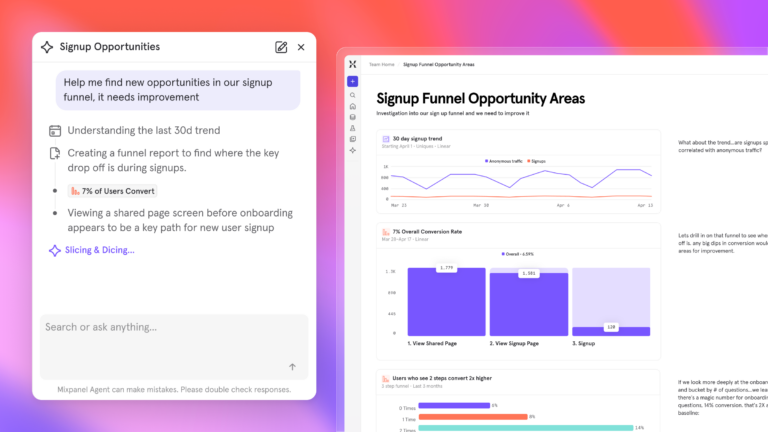
Mixpanel Agent, backed by rich experiments, feature flags, session replay, and event data, will fill in the rest so that every builder can become an expert analyst with the tools I dreamed of early in my product career.
Building for a new kind of user
At Cloudflare, which powers 20% of the Internet, I had a front-row seat to the dramatic shift in Internet traffic patterns over the past year. More than half of all traffic on the Internet is now automated, with the fastest-growing segment from a new class of user: AI agents. Traditionally, product, design, and engineering teams primarily focused on the experience of human users and treated automated traffic as noise to filter out. I believe that this needs to change and that every builder should be thinking about agents as first-class users. What’s usable and delightful looks totally different for humans and agents: The problems they’re solving are often different, so products should treat them differently. Mixpanel will help builders serve both.
Using Mixpanel to make Mixpanel better
The best products I’ve used are ones where the teams building them have a strong culture of dogfooding. The products my team built at Cloudflare started as ideas to make our own lives easier, and our own feedback made them better even before we gave them to users to play with. Leading Mixpanel’s product and design teams is a dream scenario in this regard: We get to use Mixpanel every day to make Mixpanel stronger and to learn what works and doesn’t work using our own platform. We’ll live in the same pains and joys as our users every day, forcing radical empathy and pride in what we build.
Making every builder an expert analyst
Mixpanel Agent lets any builder ask questions in plain language and get confident answers—backed by experiments, feature flags, session replay, and event data. No stats background required.
Building for a new kind of user
More than half of all Internet traffic is now automated. Mixpanel will help builders treat AI agents as first‑class users—because what’s usable and delightful looks entirely different for agents than for humans.
Using Mixpanel to make Mixpanel better
The best products are built by teams who live in them. Mixpanel’s product and design teams share the same pains and joys as our users every day—turning radical empathy into every release.
I need your help!
I’d love to hear your feedback on Mixpanel: What do you love, what do you wish we did differently, and what do you want us to build next? Log in to Mixpanel and find the Submit Feedback button at the bottom of your Home screen. And if helping shape the future of software is the kind of problem you want to work on too, please reach out—we’re hiring across product and design.