
Product roadmaps explained: Types, examples, and how to build one

As product-led growth and AI-assisted development make it easier to ship new features, prioritization and alignment are becoming an increasingly important part of product management. Because building the wrong thing is now a lot easier to do, too.
A range of inputs can help decide what to build, from customer feedback and stakeholder requests to analytics. But having that information is just the first step. Teams still need to incorporate those insights and data into a usable framework that ranks initiatives and gets everyone aligned.
That's where a product roadmap comes in—a shared framework for communicating priorities, coordinating work, and connecting decisions to business goals.
This article explains what a product roadmap is, what it should do, and how to make better roadmap decisions.
What is a product roadmap?
A product roadmap is a strategic communication document that connects product investments to business and user outcomes. It describes where a product is headed, why specific initiatives matter, and how those initiatives support broader company goals.
Here are some key questions a roadmap should answer:
- What outcomes are we trying to achieve?
- Which problems are most important to solve?
- How do these initiatives support the product vision?
- What priorities will guide product decisions over the coming months?
Product managers typically own the roadmap, but they don’t create it in isolation. Roadmap inputs can come from multiple sources, such as customer feedback, user research, sales and support teams, and more.
The product manager's role is to evaluate those inputs, identify the strongest opportunities, and create a roadmap that ensures investments translate into measurable outcomes.
Because a product roadmap’s job is to align different teams around common goals, it should provide a unified view of priorities while keeping in mind the needs of different audiences. For example, executives want to understand business impact while sales teams need directional visibility and positioning guidance for conversations with prospects.
What a product roadmap is not
A roadmap is not a detailed project plan. While it may reference features, releases, or initiatives, those elements serve the strategy, not the other way around.
It’s also not a backlog, which is a repository of ideas, requests, and potential improvements. A roadmap represents selected priorities; everything on a roadmap should have a strategic reason for being there. Most backlog items never belong on a roadmap.
Roadmaps often become crowded with requests from stakeholders who advocate for their preferred initiatives. Without evidence-based prioritization, this can turn roadmaps into collections of competing opinions and a battleground for organizational politics.
One of the most common roadmapping mistakes is treating roadmap timelines as contractual commitments. In reality, product development involves learning, iteration, and changing priorities. A roadmap should communicate direction and intent, but not go so far as to guarantee delivery schedules months in advance.
Types of product roadmaps
There’s no single roadmap format that works for every company, and the best format depends on factors like the audience, product maturity, and planning horizon.
The now-next-later roadmap
The now-next-later roadmap organizes initiatives into three broad categories:
- Now: Work currently in progress
- Next: Priorities that are likely to follow
- Later: Future opportunities under consideration
This format emphasizes flexibility and avoids creating artificial certainty around dates.
For example, a consumer application like a music streaming platform might use a now-next-later roadmap to communicate priorities like playlist improvements, recommendation enhancements, and creator tools without attaching specific release schedules.
This is often the preferred format for early-stage and fast-moving product teams.
The goal-based roadmap
A goal-based roadmap organizes work around measurable outcomes like:
- Improving activation rate
- Increasing retention among new users
- Reducing onboarding friction
- Growing enterprise adoption
Grouping by goal forces teams to connect roadmap investments directly to business impact.
Growth-stage SaaS companies often adopt goal-based roadmaps because they align product decisions with key performance indicators.
| Format | Best for | Planning horizon | Common audience |
|---|---|---|---|
| Now–next–later | Teams that need flexibility and want to avoid false certainty around dates | Rolling, no fixed dates | Early-stage and fast-moving teams |
| Goal-based | Connecting roadmap investments directly to measurable business outcomes | Quarterly OKR cycles | Growth-stage SaaS, product-led teams |
| Timeline-based | Organizations with contractual commitments, regulatory deadlines, or predictable release cycles | Quarterly or semi-annual | Enterprise software, B2B |
| Strategic / theme-based | Communicating long-term direction without specifying individual features | Annual or multi-year | Executive and board audiences |
| Release plan | Teams coordinating what ships and when across functions | Sprint or monthly | Engineering, delivery, customer success |
The timeline-based roadmap
Timeline-based roadmaps organize work by quarters, months, or release windows. For example:
- Q1: User onboarding improvements
- Q2: Reporting enhancements
- Q3: Enterprise administration features
A timeline-based roadmap works best when organizations face contractual commitments or regulatory deadlines or need to have predictable release cycles.
Enterprise software providers often use timeline-based roadmaps because customers expect visibility into planned delivery windows.
The strategic or theme-based roadmap
Strategic roadmaps focus on broad investment themes such as AI capabilities, security, or self-service adoption.
Rather than specifying individual features, these roadmaps communicate long-term strategic direction.
It’s common for executive audiences to prefer this type of roadmap, as it highlights business priorities without excessive implementation details.
The release plan roadmap
Release roadmaps focus on planned feature launches and tend to be more tactical, answering questions about what will ship and when. Although some teams may refer to these as “release roadmaps,” they’re technically more like “release plans” as they’re often more focused on communicating execution details.
Key components of a product roadmap
Regardless of format, a good roadmap should have several core elements:
- Product vision. This is a clear, broad vision that explains where the product is heading and why.
- Outcome goals. Every roadmap initiative should support a measurable outcome (like increasing activation by 15% or shortening time-to-value from 10 days to three days) to provide a basis for prioritization and evaluation.
- Themes and initiatives. Themes organize related work into strategic categories, while initiatives are major investments that drive desired outcomes. This structure helps stakeholders understand why specific projects matter.
- Timeframe. Roadmaps may not need precise dates, but they should still communicate a planning horizon. The level of specificity typically depends on audience and organizational maturity.
- Assumptions and risks. Every roadmap is built on assumptions. Documenting assumptions helps teams revisit decisions when new information emerges, and it becomes increasingly important as products evolve and user behavior changes.
How to build a product roadmap
Mature product teams all have their own specific process for building a roadmap. However, most of those processes will include iterations of five foundational steps:
1. Define outcomes first
Start by defining your objective. These questions can help guide the discussion:
- Which business outcome needs improvement?
- Which user behavior needs to change?
- Which metrics matter most?
2. Gather multiple inputs
Roadmap decisions should combine information from more than one source so that no single stakeholder, team, or data point disproportionately influences priorities. Consider sources like:
- Behavioral analytics
- Customer interviews
- Support feedback
- Sales insights
- Competitive research
3. Prioritize systematically
Prioritization frameworks can help teams evaluate opportunities more consistently. Here are a few approaches to consider:
- RICE (Reach, Impact, Confidence, Effort). Scores initiatives based on how many users they affect, the expected impact, confidence in the estimates, and the effort required to deliver them.
- ICE (Impact, Confidence, Ease). A simpler scoring model that helps teams quickly compare opportunities based on potential value, certainty, and implementation difficulty.
- MoSCoW (Must-have, Should-have, Could-have, Won't-have). Categorizes work by importance, helping teams distinguish critical requirements from lower-priority items and defer nonessential work.
4. Validate assumptions
Treat each roadmap item as a hypothesis. State the expected outcome, the metric it should impact, and how you’ll verify any changes after release (e.g., baseline vs. post-launch comparison or a defined success threshold).
5. Tailor the roadmap to the audience
Adapt the roadmap for the people who’ll be using it. You can do that by presenting the same priorities, but adjusting what you emphasize: include technical scope and dependencies for delivery teams, strategic rationale for executives, and high-level themes or problem areas for customers.
How AI is changing product roadmaps in 2026
AI-assisted development is dramatically reducing the time it takes to build and ship software. Teams can now prototype, test, and launch features in weeks rather than months, which means execution speed is no longer the primary competitive advantage. Instead, the ability to prioritize effectively becomes critical: when teams can build anything quickly, choosing the wrong thing is much riskier because faster delivery also makes it easier to scale the impact of bad decisions. This shifts the bottleneck from delivery capacity to decision quality.
At the same time, products no longer serve only human users. Today, AI agents increasingly interact with products through APIs, integrations, and automated workflows to retrieve data, execute tasks, and trigger actions without the need for a user interface. These agents generate different signals than humans, such as API calls, task completions, and automation success rates, so roadmaps that focus only on human engagement miss a significant and growing source of product value.
As a result, roadmaps are starting to function less as static planning documents and more as decision systems that support ongoing prioritization, clearer trade-offs, and alignment around outcomes as new information becomes available.
How to prioritize your roadmap with data
When teams prioritize without behavioral data, it’s tempting to rely on hunches or opinions. Data brings clarity by linking roadmap investments to real user behavior and measurable outcomes. Here are a few ways to make sure your roadmap is grounded in objective, defensible evidence.
Use funnel analysis to identify friction
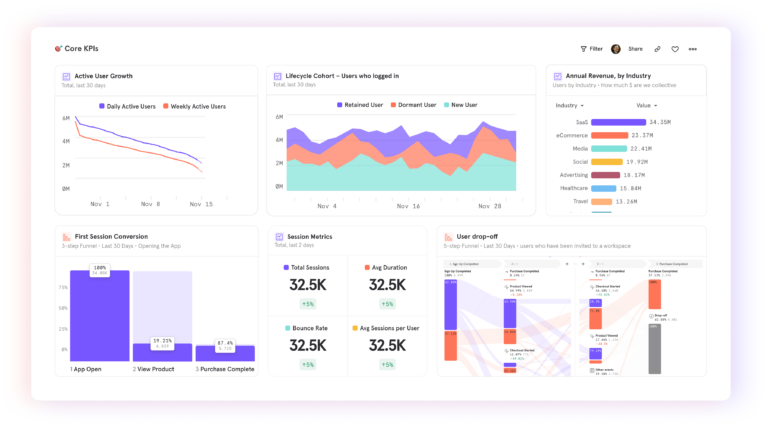
Funnel analysis reveals where users drop off before reaching value and helps product managers identify the highest-leverage opportunities.

Suppose onboarding consists of five steps, and analytics shows that 45% of your users abandon the process at step three.
That insight creates a roadmap opportunity: Rather than building another feature that a stakeholder requested, the team may discover that fixing onboarding would generate far greater impact.
Use retention analysis to identify sticky features
Not all features create lasting value. Retention analysis reveals which experiences are bringing your users back.
If users who adopt a particular feature demonstrate significantly higher retention, then that feature likely drives long-term engagement, so teams should consider prioritizing it in the roadmap.
Use cohort analysis to understand different user groups
Average behavior can hide important differences, and cohort analysis helps you dig deeper by revealing how specific groups behave over time. For example:
- Power users versus occasional users
- Enterprise customers versus SMB customers
- New users versus experienced users
Primephonic, the “Spotify of classical music,” identified three distinct cohorts or groups of listeners through customer interviews: beginners, intermediates, and advanced classical music fans.
Using Mixpanel, they discovered that advanced listeners converted to paid subscriptions at higher rates, while beginners consumed more educational content and curated playlists designed to help them discover classical music.
The team used this data to redesign the onboarding process, improving signup-flow completion rates from between 20%–26% to nearly 80%. More importantly, it gave the team a repeatable framework for prioritizing roadmap decisions around observed user behavior rather than assumptions.
Measure outcomes after launch
After launch, teams should use product data to track outcome metrics (such as adoption and retention) and test whether their assumptions held up. These insights can then feed into future roadmap decisions, reinforcing an evidence-based feedback loop.
Imagine a PM at a B2B SaaS company ships a collaboration feature based on sales requests. After launch, funnel analysis in Mixpanel’s dashboard shows that 80% of users who try the feature don’t return to it in week two.
The team then uses cohort analysis to understand why and discovers that the feature resonates strongly with enterprise users, but not SMB customers. So, in the next roadmap cycle, the team deprioritizes follow-up work aimed at SMB and doubles down on enterprise use cases to drive higher engagement in that segment.
Common product roadmap mistakes
Even experienced product teams can fall into roadmap planning traps that distort priorities and affect long-term impact. Here are the most common ones to look out for:
- Prioritizing by stakeholder. The loudest request isn’t always the most valuable opportunity, and stakeholder influence shouldn’t overshadow customer outcomes, strategic goals, and evidence.
- Committing publicly to dates too early. There are two disadvantages to premature commitments: not only do they limit flexibility, but they also encourage teams to optimize for predictability instead of learning.
- Failing to revisit assumptions. Document key assumptions before development begins, then schedule post-launch reviews to evaluate outcomes and update priorities based on what you’ve learned.
- Using one roadmap for every audience. Different stakeholders need different information. Consider tailoring roadmap views to each audience so teams can communicate the right level of detail, context, and strategic intent without overwhelming or confusing stakeholders.
- Ignoring technical debt. It can be tempting to focus exclusively on customer-facing features, but neglecting investments in platform health, infrastructure, and reliability often increases risk and limits future growth.
Product roadmap examples
Now let’s look at three examples of roadmaps for different types of organizations and how they would prioritize features based on desired outcomes.
Early-stage SaaS roadmap
This roadmap prioritizes learning and flexibility, and helps teams focus on the highest-impact opportunities while preserving the ability to adapt as customer insights emerge.
Format: Now-next-later
Primary goal: Improve activation
Initiatives:
- Now: Onboarding improvements
- Next: Self-service setup workflows
- Later: Team collaboration features
Growth-stage product-led growth roadmap
This format connects investments directly to measurable business results, making it easier to align stakeholders around common goals rather than individual features or delivery timelines.
Format: Outcome-based
Primary goal: Improve retention
Outcome: Increase 90-day retention by 12%
Initiatives:
- Improve reporting workflows
- Expand collaboration capabilities
- Reduce onboarding friction
Enterprise software roadmap
This structure supports customer expectations around delivery planning, which makes it especially useful when teams have to coordinate commitments, manage dependencies, and provide clear visibility into upcoming releases for customers.
Format: Timeline-based
Primary goal: Meet contractual obligations
Initiatives:
- Q1: Security certifications
- Q2: Compliance enhancements
- Q3: Enterprise administration controls
- Now: Onboarding improvements
- Next: Self-service setup workflows
- Later: Team collaboration features
- Improve reporting workflows
- Expand collaboration capabilities
- Reduce onboarding friction
- Q1: Security certifications
- Q2: Compliance enhancements
- Q3: Enterprise admin controls
Product roadmap software and platforms
The best product roadmap platform for your organization depends on whether you’re optimizing for alignment, execution, or decision-making. Most teams end up using a combination of tools that connect strategic planning, day-to-day delivery, and data-driven prioritization.
Here are the core roadmapping software categories to consider:
Roadmap planning software
These tools help with roadmap planning and stakeholder communication:
- Aha!: Good for structured strategy-to-execution roadmapping with strong prioritization frameworks and enterprise governance.
- ProductPlan: Lets you create clean roadmaps that are easy to share with stakeholders and updated in real time.
- Productboard: Focuses on synthesizing customer feedback and linking it directly to prioritization and roadmap decisions.
Project management tools with roadmap features
Some teams prefer to keep roadmaps closer to execution, and these tools make that easier by linking planning directly to kanban boards and workflows. Just note that because these are not true purpose-built roadmapping platforms, they may lack higher-level strategic capabilities like robust portfolio views and executive-friendly views across multiple teams.
- Notion: Flexible, all-in-one workspace where teams can build lightweight, customizable roadmaps alongside docs and specs.
- Asana: Primarily a project and task management tool. Good for connecting roadmap initiatives directly to tracked work, kanban boards, and cross-functional execution timelines.
- Linear: Designed specifically for product and engineering teams that want speed and automation.
Analytics platforms that inform prioritization
Roadmaps are only as strong as the evidence behind them, and analytics tools help ground decisions in real user behavior rather than opinions or hierarchy.
- Mixpanel: Helps teams prioritize roadmaps using behavioral data to understand how users actually engage, where drop-offs occur, and which users keep coming back.
The future of product roadmaps
When every product team can ship faster with AI, making the right decisions consistently and quickly becomes the real differentiator.
Instead of asking, “What should we build next?” product teams should ask, “What evidence suggests this investment will actually create meaningful value?”
The product roadmaps of today and tomorrow should be increasingly data-informed.
From funnel analysis and retention reporting to cohort comparisons and segmentation, Mixpanel gives teams the data and insights they need to prioritize with confidence, measure outcomes after launch, and continuously improve roadmap decisions.
| You can learn more about Mixpanel and get started for free here. |