

What is experiment velocity? A product manager’s guide.

AI has made it faster and easier to generate code. Product development teams can build, prototype, and deploy faster than ever with new tools and vibe coding options.
But the process of validating whether new features actually improve customer outcomes through experimentation, measurement, and analysis hasn't accelerated at the same pace. AI-generated code also often comes with more errors and security risks and generally requires more validation and oversight than code generated by humans.
This has created a velocity gap: deployment velocity has increased, but the speed at which we can test hypotheses and validate outcomes has remained the same.
Faster experiment velocity is the key to closing that gap. What separates strong product orgs now is how quickly they learn, not how quickly they build, and that speed depends on whether your behavioral data and your experiments actually talk to each other.
Let’s take a look at what experiment velocity is, how to measure it, and why it matters.
| Read the ebook: The New Testing Paradigm: Experimentation in the age of AI. |
What is experiment velocity?
Experiment velocity is the speed at which a team moves from a question or a hypothesis to a validated, evidence-based answer.
In other words, experiment velocity is the rate at which product organizations learn.
Teams will often talk about deployment velocity, or how quickly they can ship changes. As we mentioned above, AI has accelerated this process significantly. Teams can get from idea to MVP faster than ever before.
But the pitfalls of AI code generation (tech debt, possible defects, security concerns) also mean that teams have less confidence in what they’re shipping.
Experiment velocity is how quickly teams can test and validate whether new code has the expected effect.
When deployment velocity outpaces experiment velocity, features ship without clear success criteria, and metrics move without a clear cause and effect.
We need to speed up and reimagine experimentation for AI-assisted development.
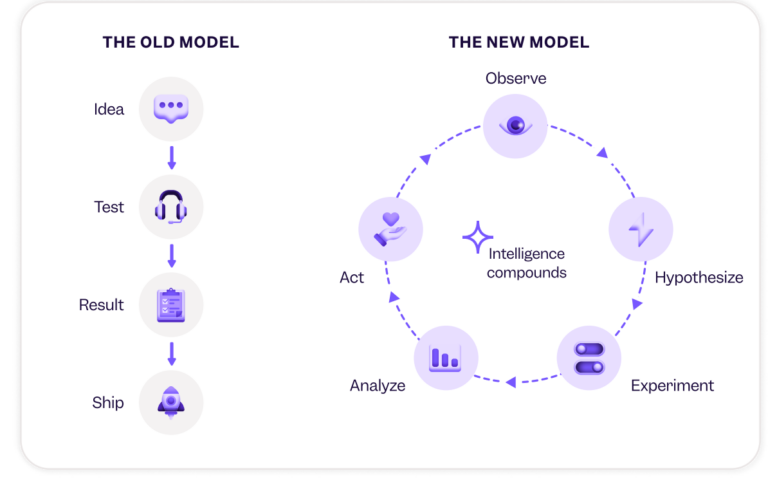
What experiment velocity is not
Experiment velocity is about better questions and faster learning, not simply about running more experiments or shipping faster.
It’s also not about measuring how much work a team completed in a sprint. Shipping faster without validation increases risk, and focusing on output over impact reduces the effectiveness of different initiatives.
The learning loop that powers faster experiment velocity
In the AI era, the new mental model for experimentation is a learning loop that helps teams perform more useful experiments faster.
- Observation to identify opportunities: What are users doing?
- Form a hypothesis: Based on what’s observed, what improvements could be made?
- Design and run the experiment: Create a statistically significant test to prove or disprove the hypothesis
- Analyze results: What did we see, and what does that tell us?
- Back to observation: The loop continues, informed by what we’ve learned
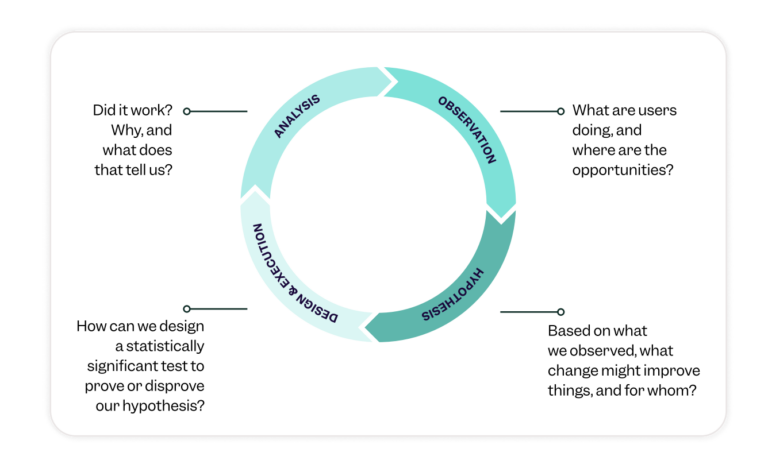
Experiment velocity speeds up when teams reduce time across the full loop. But fragmented experimentation models can make that hard to accomplish: disjointed tech stacks mean that data lives in separate platforms. Teams that don’t communicate redefine metrics for each new project. Each experiment starts from scratch.
Connected analytics and experimentation help accelerate experiment velocity. Behavioral data informs hypotheses and analysis, with context that informs the entire process. This means that the intelligence gathered compounds, experiment after experiment.
| See what connected analytics and experimentation can do with Mixpanel’s Experiments. |
How to measure experiment velocity
There’s no single experiment velocity metric, so many teams measure a combination of throughput, efficiency, and actionability.
Metric 1: Experiments per team per quarter
This measures learning cadence and helps teams gauge output. More validated learnings create more opportunities for improvement.
Note: Shipping more experiments on its own won’t improve experiment velocity (or learning in general) without connected intelligence. If you don’t have the right data feeding your experiments, you risk running more experiments without increasing the knowledge gained.
Metric 2: Time from hypothesis to decision
Measuring the amount of time between creating a hypothesis and making a decision gives important information about decision velocity and operational efficiency.
Metric 3: Percentage of experiments that produce action
This estimates learning conversion and how consistently experimental insights lead to product decisions. Actions include things like shipping, iterating, killing a feature, or reprioritizing roadmap items. As a subsection of this, it’s also valuable to track rollback rate: How often did unexpected results force a rollback?
Why experiment velocity matters
Even before AI changed the landscape, experiment velocity was already crucial for teams that want to ship quickly and build competitive products.
One of the main reasons for this is simple: Most hypotheses don’t work out.
When Microsoft’s experimentation team audited years of well-designed and well-executed A/B tests they had performed, they realized that only about one-third improved the intended metric. But that doesn’t make the experiments themselves failures, since they gave them the data they needed to act.
Even smart, experienced product teams will have wrong hypotheses a significant amount of the time. Testing and validating those hypotheses before acting on them is key, and being able to test and validate theories quickly allows PM teams to act quickly. Learning speed matters more than confidence, and small bets outperform large, time-consuming assumptions.
Collecting evidence quickly improves prioritization, which helps teams build better roadmaps. Smaller experiments also reduce risk. Teams that spend less time debating and more time validating can also build and maintain greater momentum.
| Watch the webinar about closing the velocity gap to learn more: Experimentation in the AI era |
How small experiments at greater velocity compound
At MXP London, Bhavesh Vaghela, CPTO at London Marathon walked the audience through the London Marathon ballot flow.
His team identified friction within a specific user journey and ran a series of targeted micro-experiments to optimize interactions along that path. The result was a five percent increase in conversions, which was worth approximately £500,000 based on ballot volume.
These smaller experiments at higher speed were only possible because AI removed the development constraint that used to make only big bets worth the effort. Building variants has become cheaper and faster, which makes these sorts of experiments possible at much higher velocity.
When building a variant is cheap, the math on marginal gains changes entirely.
| Learn more about AI in product development: Here's what regulated industries know about AI in product development that others don’t. |
The AI era has made experiment velocity a competitive advantage
In the AI era, speed is becoming table stakes. The durable competitive advantage is how quickly your organization turns experiments into validated knowledge. Competitors can copy features, AI tools, and even code. They can’t copy the accumulated organizational learning that intelligence can provide.
Start putting your intelligence to work today. See how experiments and feature flagging work together in Mixpanel, or read our product experimentation guide to learn more.